

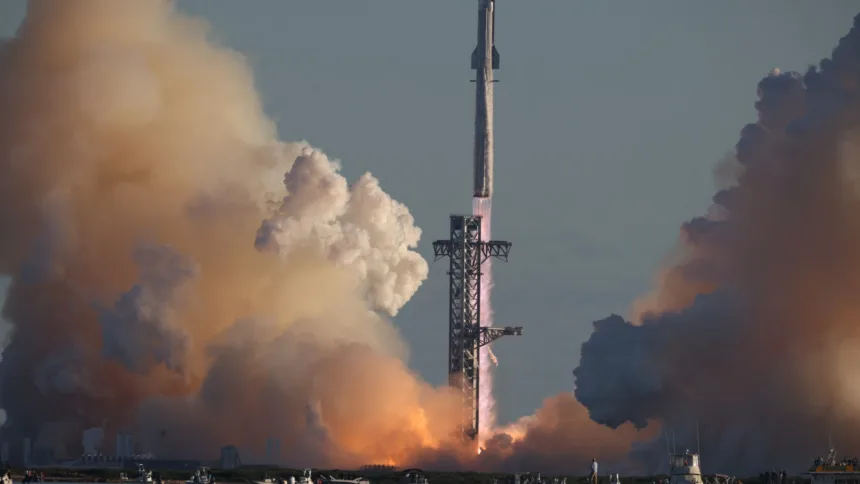
SpaceX called off a planned catch of its Super Heavy booster on Friday during Starship's 15th test flight, citing safety concerns, and diverted the giant first stage into the Gulf of Mexico, where it burst into flames.
The scrubbed catch leaves the upper stage, known as Ship 42, as the flight's remaining shot at history. It reached orbit, and the mission plan calls for it to stay there for as long as 22 hours before returning to Starbase on Saturday to be snatched midair by the launch tower's mechanical arms.
SpaceX has caught the booster on three earlier test flights but has never caught a second stage. This was the first time the company tried to recover both pieces of the rocket on one mission.
Starship lifted off at 4:47 p.m. Central time from SpaceX's South Texas launch site. Minutes later, observers at Starbase heard the booster's sonic boom and watched its fiery plunge offshore. SpaceX did not immediately explain why it aborted the catch.
The company still has an escape hatch for the ship. If more safety concerns surface, the mission team can end the flight early and guide Ship 42 to a controlled splashdown in the ocean.
Once in orbit, the ship released 26 Starlink satellites, matching the number deployed on the previous test flight. Three of them carried cameras meant to inspect the ship's heatshield after they separated.
The satellite drops show why Starship matters to SpaceX now, well before any trip to the moon or Mars. Starlink is the company's profit center, and its constellation already counts more than 11,000 active satellites in low Earth orbit. SpaceX has said one Starship can carry up to 60 Starlink v3 satellites, roughly 20 times what earlier Falcon 9 rockets could lift.
NASA is relying on a Starship-based lander to put astronauts on the moon as early as 2028 and plans to test it, along with Blue Origin's Blue Moon lander, in low Earth orbit next year on Artemis III. NASA Administrator Jared Isaacman congratulated the SpaceX team on X, pointing to the video beamed down from orbit over Starlink.
We are looking forward to some of that on-orbit Starlink capability on Artemis III.
Jared Isaacman, NASA administrator
Standing 407 feet tall and producing 17 million pounds of thrust at liftoff, Starship is the world's biggest and most powerful rocket.
The Federal Aviation Administration authorized the launch earlier Friday. Hours later, the agency ordered a nationwide ground stop over communication problems at multiple air traffic control centers, but an FAA spokesperson said the SpaceX license was not affected.
Analysts at William Blair wrote Friday that SpaceX is likely a full decade ahead of its rivals in launches, adding that a failed catch would mean a delay of only a few months and would not be very consequential.