

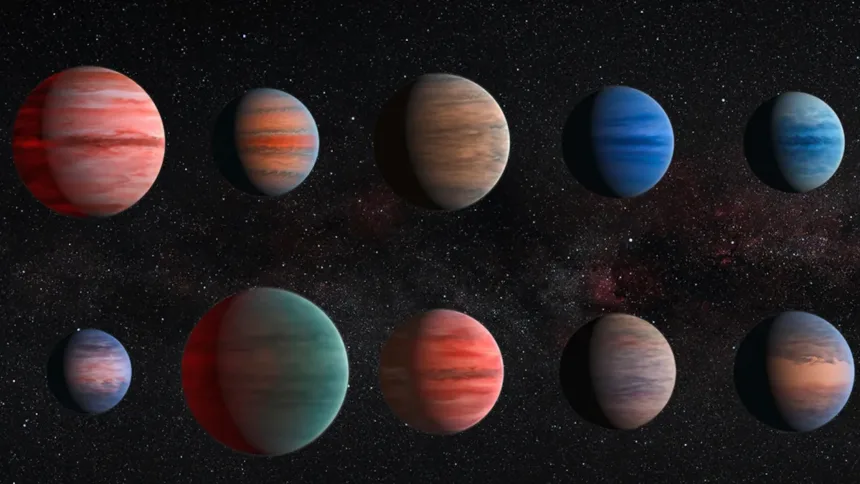
Astronomers have watched a giant exoplanet disappear from view for the first time. The planet, a hot Jupiter called TOI-2535 b, still exists. Researchers say a nearby gas giant is pulling its orbit out of line, so it no longer passes in front of its star as seen from Earth.
The finding appears in a study in Astrophysical Journal Letters and rests on data from NASA's Transiting Exoplanet Survey Satellite, known as TESS. Samuel Yee and Erik Petigura of the University of California, Los Angeles, are among the co-authors.
TOI-2535 b lies roughly 1,000 light-years away. Though it resembles Jupiter in some respects, it sits closer to its star than Mercury does to the sun, completing an orbit every 8.25 days compared with Mercury's 88.
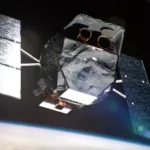
TESS began tracking the planet in April 2019. The telescope finds planets by catching small dips in starlight when an unseen world crosses in front of its star.
Over the following seven years, the planet's crossings kept missing their schedule, arriving as much as six hours earlier or later than forecast. The dips also grew shallower and briefer. In March, the planet failed to appear at all during the telescope's scan of the system.
The research team now concludes that the hot Jupiter has a very close gas giant companion whose orbit is noticeably tilted. The two worlds wobble like a pair of spinning tops, gradually knocking each other out of alignment until they drop out of Earth's line of sight.
We think of the universe as resembling clockwork, where everything is regular, but that’s not true
Samuel Yee, UCLA astronomer and study co-author
Yee called it the most extreme case seen so far because the planets interact so strongly. He said the orbit is tilting fast enough that the transit vanished while astronomers were observing it.
Petigura linked the effect to the reason solar and lunar eclipses do not recur on a fixed cycle. The moon's orbit is tilted, a legacy of its violent formation after a collision with Earth; were it perfectly aligned with Earth's path around the sun, he said, an eclipse would occur every month.
The team's calculations suggest TOI-2535 b will not cross its star again for another 30 to 50 years. The researchers may spot its companion planet sooner.