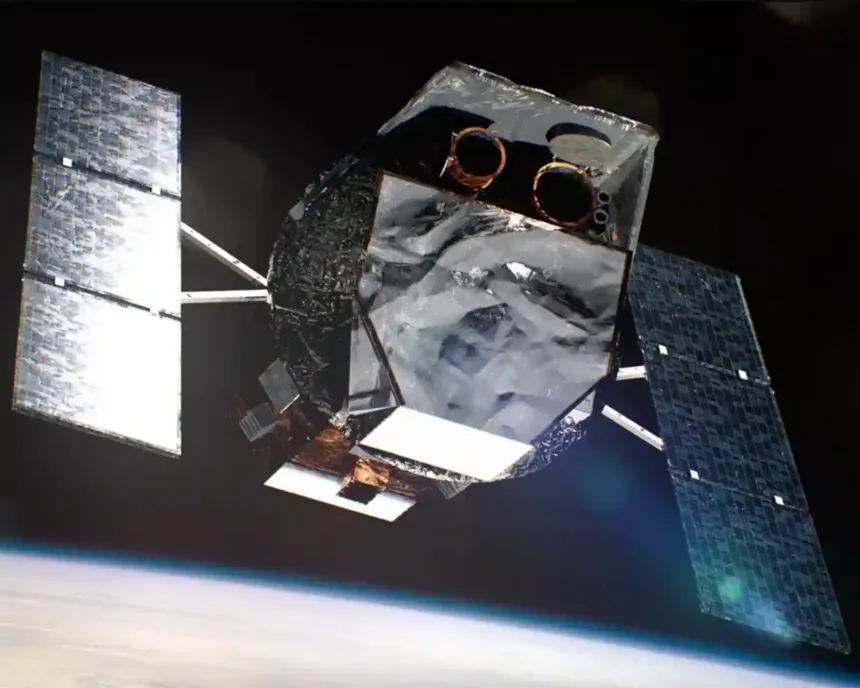
NASA's Swift Observatory fell back to Earth on Wednesday, reentering the atmosphere over Indonesia's North Sumatra region at 7:39 a.m. ET and ending a 22-year hunt for the universe's most violent explosions.
NASA said much of the roughly 3,200-pound spacecraft burned up, though the agency expected some denser parts to survive. How much of it reached the surface was not immediately known.
The U.S. Space Force, which tracked the descent with NASA, confirmed the reentry. Beforehand, NASA put the chance of anyone being hurt at about 1 in 2,100 and said any surviving debris would fall between 20.6 degrees south and 20.6 degrees north latitude.
The telescope came down hours after the agency's central forecast of about 3:30 a.m. ET, a prediction that carried an 11-hour margin of uncertainty in either direction.
A rescue that never arrived
Swift's end followed a failed rescue. NASA hired Katalyst Space to lift the telescope into a higher orbit, and the company launched a three-armed robot named Link in July, but the craft hit trouble soon after launch and never got within seven miles of its target.
The decision to let Swift fall was made in August. Link itself crashed back to Earth in September.
Intense solar activity over the past few years had steadily pulled the observatory lower. It kept returning observations until late October, when NASA judged it too low to hold steady and shut its systems down; last month it was estimated to be circling about 171 miles up.
Two decades of cosmic alerts
Launched on Nov. 20, 2004, Swift was built for a two-year study of gamma-ray bursts and exploding stars. It ran about 11 times longer than planned, recording more than 2,000 of those bursts and 1,400 exploding stars.
Gamma-ray bursts are brief, intense flashes of radiation that NASA says arrive about once a day from every direction, and scientists still do not know what produces them. The telescope took its name from its ability to swing quickly toward such events.
Swift also acted as a first responder for the Hubble and Webb telescopes, issuing alerts so those and other facilities could study events in more depth. As recently as July, it watched a black hole drifting far from its galaxy's core rip apart a star.
Scientists are still working out how to replace what Swift did. John Nousek, the Pennsylvania State University astronomer who led its control team, said he hoped lessons from the mission would speed discoveries on future spacecraft.
We've known this day would come since before Swift was launched. At least in low-Earth orbit, what goes up must come down.
John Nousek, Pennsylvania State University astronomer who led Swift's control team
Hubble faces a similar threat
NASA is now asking private companies whether they could boost Hubble's orbit, upgrade its systems or steer it to a controlled reentry. Launched in 1990, Hubble is also losing altitude to solar storms and could fall by the mid-2030s, according to recent analyses; any mission would need to happen by 2032.
Hubble still has important science ahead of it
Jared Isaacman, NASA Administrator
Nicky Fox, NASA's science mission chief, said the agency has more time to explore options for Hubble than it had during the rushed effort to save Swift.