Virginia and the District of Columbia went to federal court Saturday in a joint attempt to stop construction of President Donald Trump's proposed triumphal arch at Memorial Circle in Washington. The administration has said work could begin as soon as next week.
The 45-page complaint, filed in the U.S. District Court for the District of Columbia by Virginia Attorney General Jay Jones and D.C. Attorney General Brian Schwalb, describes the project as plainly illegal and impossible to defend in court.
The two jurisdictions are seeking a temporary restraining order. They also want the court to require the administration to obtain congressional authorization before any construction starts.
Why timing matters
Timing is central to the case. The National Capital Planning Commission is expected to hold its final vote on the arch's design on Thursday, Nov. 5. The administration has told a court that construction could begin that same day if the commission grants approval.
The attorneys general argue that the court must act before work begins. They predict that once construction is underway, the administration will claim, as it has in other cases, that halting the project would harm the federal government and create security risks.
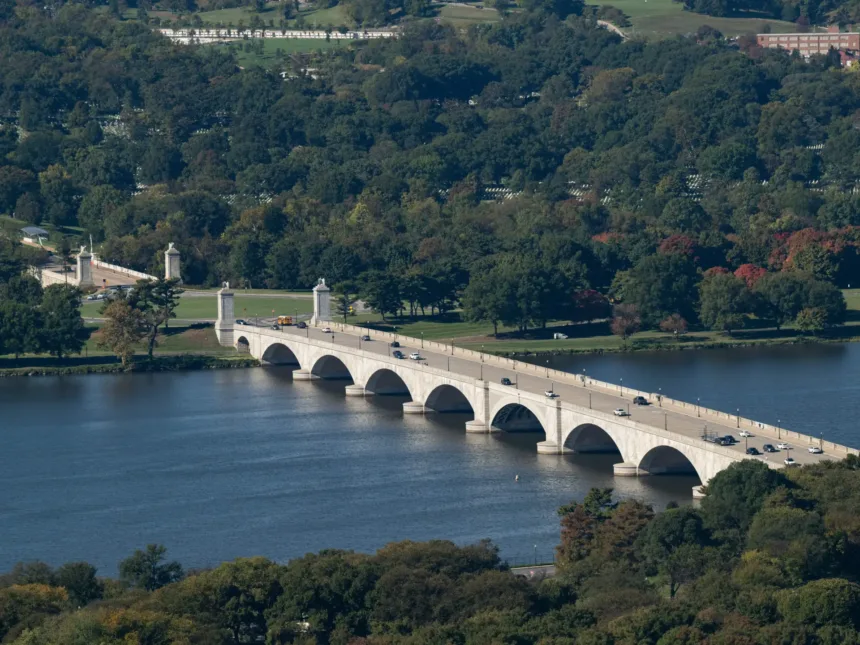
According to the lawsuit, the site sits on a major traffic route between the District and Virginia, on an island in the Potomac River within the capital's monumental core. The complaint says the three-year construction period would tie up traffic between the two jurisdictions, cause pollution and stormwater runoff into the Potomac, and interfere with emergency services.
The suit also raises concerns about emergency response in a region where joint operations are routine. It cites the January 2025 midair collision between a military helicopter and an airliner, which killed 67 people.
The attorneys general say both governments would face immediate, costly steps to assess and reduce the project's effects. They describe those costs as unrecoverable and accuse the administration of failing to consider them or adequately consult either jurisdiction during what they call a rushed approval process.
The legal arguments
On the legal merits, Jones and Schwalb argue that the administration is violating the Commemorative Works Act by bypassing specific congressional authorization. They also argue that it is violating the Height of Buildings Act because the arch would exceed 130 feet. In addition, they allege violations of the National Environmental Policy Act and the National Historic Preservation Act.
In a statement, Jones said Virginia takes great pride in being home to Arlington National Cemetery. He called the arch an illegal vanity project and an affront to the cemetery, and he pledged to litigate vigorously.
Schwalb said in a separate statement that construction of the arch is flagrantly illegal and would cause serious, immediate harm to the District and its residents. He said the suit was being filed now to protect the city's interests.
A White House spokesperson called the planned arch one of the most iconic landmarks in Washington and the world. The spokesperson said it would serve as a gateway to Arlington National Cemetery for veterans and the families of the fallen. The spokesperson did not address a direct question about the lawsuit, and the White House and the Interior Department did not respond to other requests for comment.
What the plans show
The arch would rise 250 feet, making it 100 feet taller than the Statue of Liberty. It would also be more than twice the height of the 99-foot Lincoln Memorial and taller than France's Arc de Triomphe. The structure would stand between Arlington National Cemetery and the Lincoln Memorial.
On Friday, the government submitted a 106-page plan for the arch. It calls for a large bronze statue of a winged Lady Liberty holding a torch with an eternal flame, along with an observation deck facing east and west and two mezzanines. Interior spaces would include program areas, offices and a fire command center. The project also proposes major traffic changes, including rerouting vehicles onto nearby roads.
Trump has said the arch would serve a national security function. In September, he wrote on Truth Social that it would be equipped to house drones and snipers and to store sniper ammunition. The final plans submitted to the planning commission, however, do not include those military features. The secretaries of defense and homeland security recently filed sworn declarations in a separate case to support the administration's argument that the project is needed for national security.
Other court fights
Saturday's complaint is the third lawsuit against the arch. The first was filed in February by a group of Vietnam War veterans and an architectural historian. Arlington County followed with its own suit on Oct. 8, arguing that the project would cause significant harm to residents and likely require changes to nearby flight paths.
U.S. District Judge Tanya Chutkan, who is overseeing the veterans' case, is weighing a preliminary injunction that would freeze construction while that case proceeds. At a hearing Friday, she did not rule immediately but said she would act quickly. She had previously ordered the administration to give the court 48 hours' notice before beginning any construction-related activity.
During Friday's hearing, Chutkan asked what the urgency was and how the government would be harmed by an injunction. Administration lawyer Robert Stander called the arch a high-priority project and said court intervention would impede the government's work.
In the new case, the court ordered both sides to confer and agree on a proposed briefing schedule for the restraining order request by Saturday evening.
The arch has already cleared early reviews. The U.S. Commission of Fine Arts, whose members were all chosen by Trump, gave it initial approval. Earlier this year, the National Capital Planning Commission, led by Trump appointees, approved initial construction plans.
The project is one of several Trump efforts to reshape the capital that have drawn legal challenges. He has also cited national security in defending a new White House ballroom, which the Supreme Court allowed to proceed despite a challenge from the National Trust for Historic Preservation.