NASA's twin ESCAPADE spacecraft are set to fire their thrusters while swinging close past Earth, pairing those boosts with the planet's gravity to hurl themselves toward Mars. Their target is one of the solar system's open questions: how Mars lost its ancient atmosphere.
The first probe is scheduled to make its pass on Nov. 7 and the second on Nov. 9. At closest approach, each will be roughly 965 to 1,770 kilometers above the surface.
Each trans-Mars injection burn is expected to last about nine minutes. The burns should lift the spacecraft's speed from about 10.14 kilometers per second to 10.78 kilometers per second, a gain of more than 2,000 kilometers per hour.
The detour was necessary because ESCAPADE did not launch during a standard Mars window, which opens about every 26 months. Instead, the probes waited near the Earth-Sun Lagrange point 2 before heading back toward Earth for the powered flybys.
That delay produced a scientific bonus. The pair flew through Earth's magnetotail and became the first spacecraft to observe it, with results expected to be released soon.
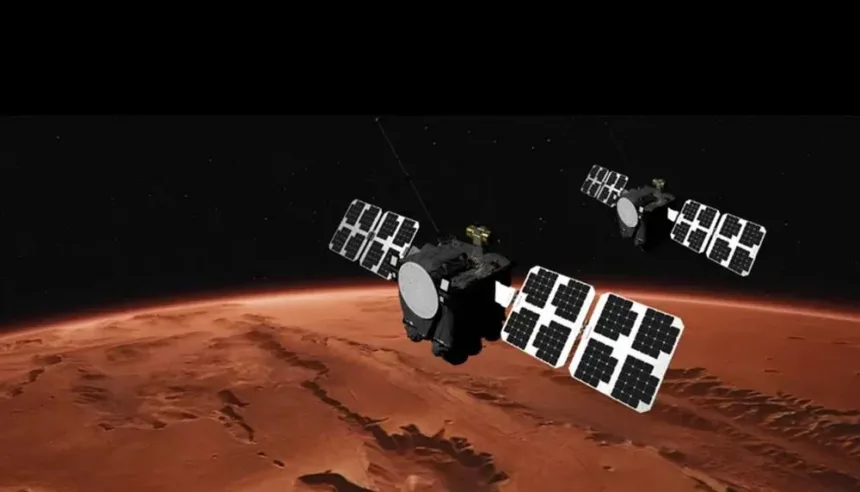
ESCAPADE, short for Escape and Plasma Acceleration and Dynamics Explorers, consists of two identical craft named Red and Blue. They will measure how the solar wind interacts with what remains of Mars' magnetic field, and they will be the first spacecraft to fly in formation around the planet.
Evidence increasingly suggests Mars was once warm and wet, which would have required a far thicker atmosphere than its current thin carbon dioxide layer. Scientists propose that after the planet's molten core cooled and its global magnetic field vanished, ultraviolet radiation from the sun drove that atmosphere into space.
Patches of magnetism still survive, locked into iron-rich chunks of the crust when the planet's dynamo failed billions of years ago. Those crustal fields also create similar patches in the upper atmosphere, giving ESCAPADE something to study.
Two spacecraft are needed because solar wind interactions can shift on very short timescales. A single probe could not tell whether a change it recorded came from the interaction itself or from its own movement; a pair flying together, in what NASA calls a String of Pearls formation, removes that doubt.
That formation will last through Science Phase A, about six months. In Phase B, the probes will operate more independently for about five months, with Blue dropping to an orbit of about 7,000 kilometers and Red rising to about 10,000 kilometers. The spacecraft should keep working for many years after the nominal mission ends.
Skywatchers hoping to catch the flybys will almost certainly need a telescope. The probes, each about the size of a refrigerator, should appear as a pair of dim objects moving against the stars.