
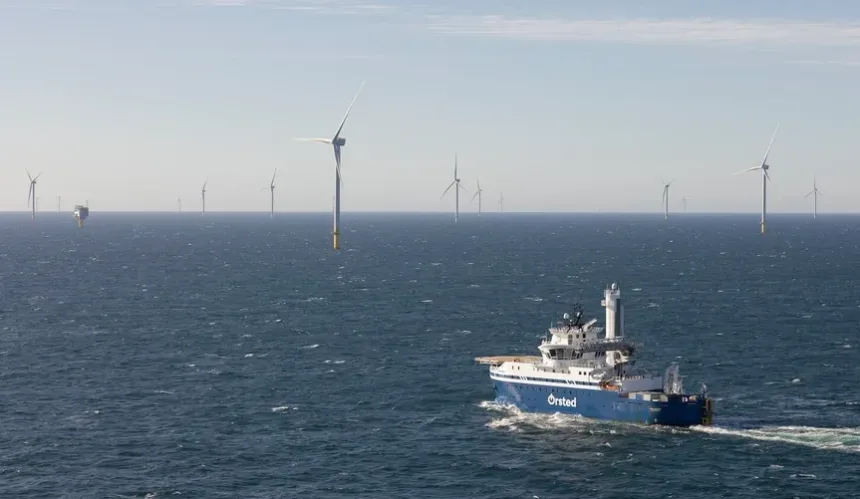
Revolution Wind, a 704-megawatt offshore wind farm serving Rhode Island and Connecticut, is now generating at full capacity, its Danish developer Ørsted told investors Thursday. The project got there despite the Trump administration halting its construction twice.
Ørsted said the 65-turbine, roughly $6 billion project reached that level in October. Its output, enough for about 350,000 homes, goes to three regional utilities: Rhode Island Energy, Eversource Energy and United Illuminating.
A legal fight that has not ended
Washington is still trying to undo it. Interior Department attorneys asked a federal court in October for permission to revisit the agency's 2023 approval of the wind farm's construction and operations plan. Experts said the request clouds the future of a project that is already finished.
That motion sits before U.S. District Judge Royce C. Lamberth in Washington, who has sided with developers against the administration twice before. Interior officials had argued that Revolution Wind and other Atlantic Coast projects could interfere with military radar.
The first shutdown came in August 2025, when Interior cited unspecified national security threats; a federal judge threw that order out a month later. At the end of that year, the department froze every one of the five offshore wind projects then being built.
Savings for ratepayers
Courts eventually lifted each of those orders. By then, developers had absorbed heavy losses and come close to blowing key deadlines, and the stoppages had cost Ørsted a lot of money while sidelining hundreds of workers.
Every single time the Trump administration has tried to block offshore wind in the courts, they have been shot down.
Katie Segal, senior director of offshore wind, Environmental League of Massachusetts
Connecticut's Department of Energy and Environmental Protection estimates the project will save customers about $500 million a year beginning in 2028. Eversource and United Illuminating customers pay $99 per megawatt-hour for its power through the public benefits charge.
The farm started feeding the New England grid in March. It is expected to cover 5% of Connecticut's electricity demand and 20% of Rhode Island's.
It is the third utility-scale offshore wind farm in the country to reach full commercial operation, following South Fork Wind near New York and Vineyard Wind near Massachusetts. Vineyard Wind, slightly larger, hit full power in late October.
The national pipeline has shrunk sharply. BloombergNEF projected 39 gigawatts of U.S. offshore wind by 2035 before Trump's second term began; it now expects just 5.9 gigawatts, roughly the projects already finished or under construction at the start of last year.
Connecticut Sen. Richard Blumenthal, a Democrat, hailed the start of a new electricity era, and Rhode Island Gov. Dan McKee, also a Democrat, praised the project. An Eversource spokesman, William Hinkle, called it an important milestone as demand rises.
Not everyone welcomed the news. Michael Lombardi, who leads the anti-offshore-wind group Green Oceans, said the farm hurts fishermen and the environment, and that his organization backs the administration's effort to reexamine the operations permit.
Ørsted said more than 1,000 union workers built the project, with onshore assembly at the State Pier in New London. The company also spent $120 million redeveloping ports in Connecticut and Rhode Island that could serve future projects.
Its next project, the 924-megawatt Sunrise Wind off Long Island, now has all of its turbine foundations in place and is about 60% complete. Ørsted expects it to be fully operational in the second half of next year.