
Anthropic is preparing a stock market debut likely in mid-November, putting the maker of the Claude AI models in front of public investors days after midterm voters sharply rebuked artificial intelligence and the data centers that power it.
Investors expect the company to seek a market value between $1 trillion and $1.5 trillion, a step back from the $2 trillion figure that circulated in recent months. Anthropic would be the first pure-play AI company to list publicly.
The timing is awkward. On Thursday the Nasdaq suffered its worst drop in 19 months, sinking 11% below its record on fears that costlier borrowing could slow data center construction, after October delivered the index's weakest month since March 2025. Chipmakers and neocloud providers have taken the heaviest losses.
Anthropic's filings show how heavily it is betting on that buildout. An amended prospectus filed this week lists purchase commitments and leases totaling about $895.4 billion, nearly all of it for compute and infrastructure. The company also warned that opposition to data centers has become more organized and that its profile could bring extra scrutiny to projects tied to it.
A ballot-box backlash
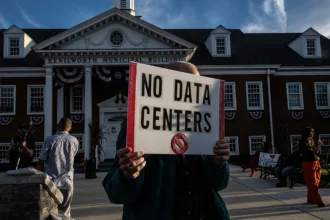
That opposition was on full display Tuesday. Democrats won control of Congress and ended longtime Republican control of governorships in Texas, Ohio, Georgia, Nevada and Iowa, several of them data center hot spots, with many winners vowing to rein in the facilities.
Data Center Watch, a project of AI security consultancy 10a Labs, found that 32 of 34 winning gubernatorial candidates in decided races back stronger regulation or restrictions. Twelve support outright bans or moratoriums.
Local voters were blunter still. Polling and data firm Redbud Consulting tracked 47 data center referendums across 44 municipalities in 12 states and found restrictions approved in 44 of the 45 contests where counting had finished.
One large voter survey found roughly three-quarters of voters oppose a new data center in their own community, with majorities against in red and blue states alike; exit polling showed most self-identified Republicans shared that resistance. Still, only about a quarter called the issue crucial to their congressional vote, far fewer than cited corruption or the cost of living.
Campaigns spent more than $380 million on television ads mentioning data centers, according to AdImpact data, with Democrats outspending Republicans on the topic by more than 3 to 1.
Morgan Stanley analysts called Democrat Gina Hinojosa's defeat of Texas Gov. Greg Abbott the most important result for data center development and said Democrat Amy Acton's win in Ohio creates significant risk of project delays there.
A question of trust
University of Virginia behavioral scientist Maura Austin argued that a lofty valuation plays into the image of big tech and billionaires that voters rejected. Georgetown finance professor Reena Aggarwal said a public listing alone draws attention, and AI's hot-button status will amplify it.
What Anthropic is doing when they're going public with such a high valuation is they're really leaning into that big tech, billionaire kind of caricature.
Maura Austin, behavioral scientist, University of Virginia
Matt Kennedy, a senior IPO strategist at Renaissance Capital, countered that public markets force more transparency and that Anthropic should face no harsher spotlight than rival OpenAI simply for being public.
Chief executive Dario Amodei has acknowledged the problem. In a post on X in August, he attributed souring views of AI to a crisis of trust, saying people believe companies, government and the tech industry are constantly plotting against them.
A University of Southern California survey released Monday found 71% of respondents do not trust big tech companies at all to act in society's best interest on data center development.
Elsewhere in the industry, OpenAI published a framework Thursday asking policymakers for clear rules on how data centers are built. Dan Diorio of the Data Center Coalition said winners who promised moratoriums will likely try to deliver, but warned that host communities could lose tax revenue and payments from tech companies.