New Zealand's general election ended Saturday night without a clear winner. With 95% of ballots counted, the governing center-right National Party and the opposition Labour Party each had just under 30% of the vote, separated by fewer than 4,000 votes.
National held a lead of roughly 3,500 votes late Saturday. Preliminary figures give Prime Minister Christopher Luxon's coalition, which pairs National with the pro-business ACT and the right-wing populist New Zealand First, a combined 67 seats, the thinnest of majorities.
That edge may not hold. Special votes, including ballots cast by New Zealanders abroad, will be counted over the next three weeks. They typically favor left-leaning parties and have shifted preliminary results in each of the last three elections. Final results are due November 27.
Luxon declared that National was again the largest party in parliament and said it had a pathway to forming the next government.
Labour leader Chris Hipkins, noting that neither major party appeared able to govern alone, told supporters that the next parliament would demand compromise and a search for common ground.
New Zealand has spoken. It may take us a little bit longer to figure out exactly what it is that you've said,
Chris Hipkins, Labour Party leader
If the right-wing bloc loses its majority, the centrist Opportunity Party could become the kingmaker. Projected to win seven seats, it would clear the 5% threshold and enter parliament for the first time since its founding in 2017. Luxon has previously ruled out working with it.
The lead changed hands as the count progressed. With just over 42% of votes tallied, Labour was narrowly ahead at 29.71% to National's 29.41%, followed by the Green Party at 13.96%, ACT at 10.63% and New Zealand First at 9.41%.
The new parliament is also set to be the biggest in the country's history. Under New Zealand's mixed-member proportional system, voters choose both a party and a local candidate, and the chamber usually holds 120 seats. Preliminary results point to 130 because of an effect known as overhang.
Voters weighed the economy above all. The campaign centered on living costs, with basic goods expensive and joblessness at its worst level in over ten years.
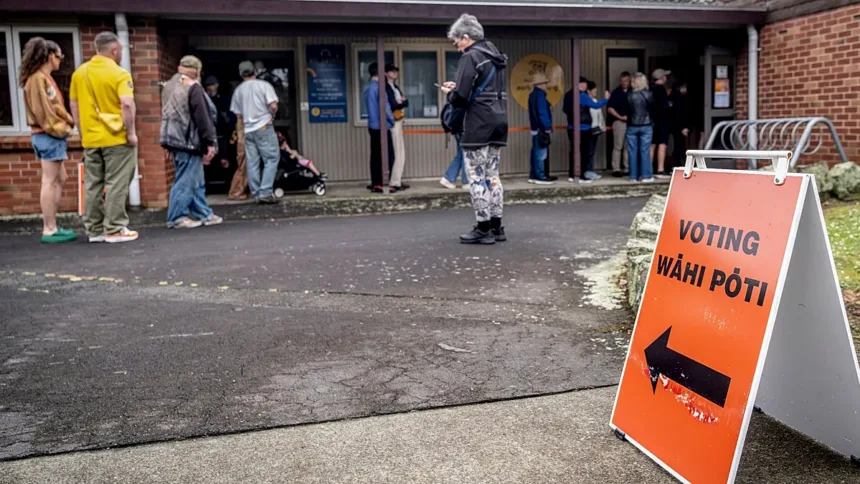
Ballots could be cast starting October 26, and nearly 1.7 million of the country's 3.8 million eligible voters had done so by Thursday, according to the electoral commission. Strict laws barred campaigning and media coverage of politics on election day itself.