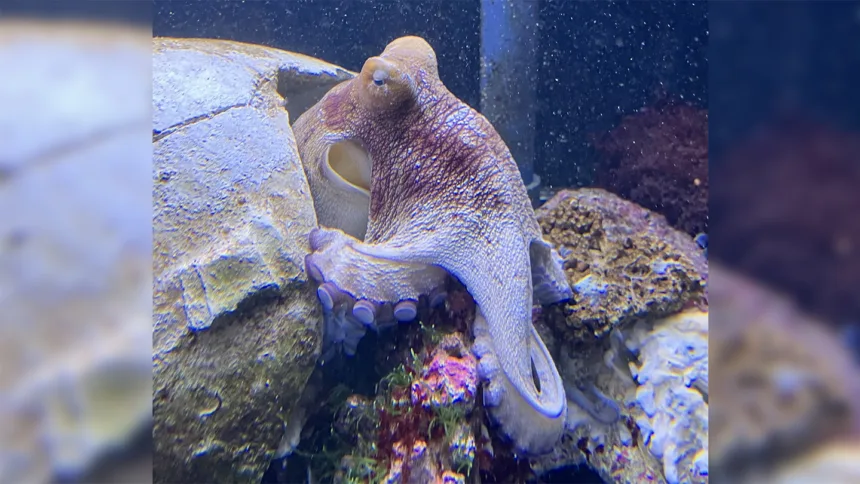
Octopuses that slip through openings near the width of their heads follow a consistent routine of three or four moves, with the extra move reserved for tighter holes. The finding appeared Nov. 5 in the Journal of Experimental Biology.
The researchers, including Michael Kuba of Italy's University of Naples Federico II and Wenci Xin of the National University of Singapore, worked with three common octopuses and four Mayan octopuses.
An octopus's stiffest structure is the cartilage case shielding its brain, so the team used the gap between each animal's eyes as a proxy for that width. Those eye spans ran from roughly 0.6 to 1.3 inches.
Each octopus then went into a clear acrylic box joined to another by a hole cut slightly larger or smaller than its own eye span. Cameras recorded what followed.
With the roomier hole, common octopuses first probed the opening, then fed a single arm through, usually one of the two front arms on the left side. More arms followed before two of them reached back, gripped the starting box's wall with their suckers, stiffened and shoved the head, mantle and remaining arms across.
On average, a crossing took about 20 seconds.
A narrower hole let fewer arms pass at a time, so common octopuses broke the final push in two. They drew every arm through first, then compressed the mantle and worked the rest of the body after it.
Mayan octopuses showed far more caution. Faced only with the smaller hole, they lingered in another corner without touching it; given a second, wider opening, they felt around the small one and then chose the bigger exit.
Kuba said the gap between species may reflect biology or habitat. Mayan octopuses live among sand and rock, he said, where they may duck beneath stones but seldom have to force their way through holes.
The skill matters for survival, Kuba said, helping octopuses reach concealed prey and avoid predators. Robyn Crook, who studies evolutionary biology at San Francisco State University and had no role in the project, said the behavior is widely known yet its strategies had never been examined systematically.
Xin said the team hopes the animals will inspire soft robots able to change shape to reach confined spaces. Such machines today tend to be built like snakes, and Crook said watching octopuses tackle slits or tubes could supply further design ideas.