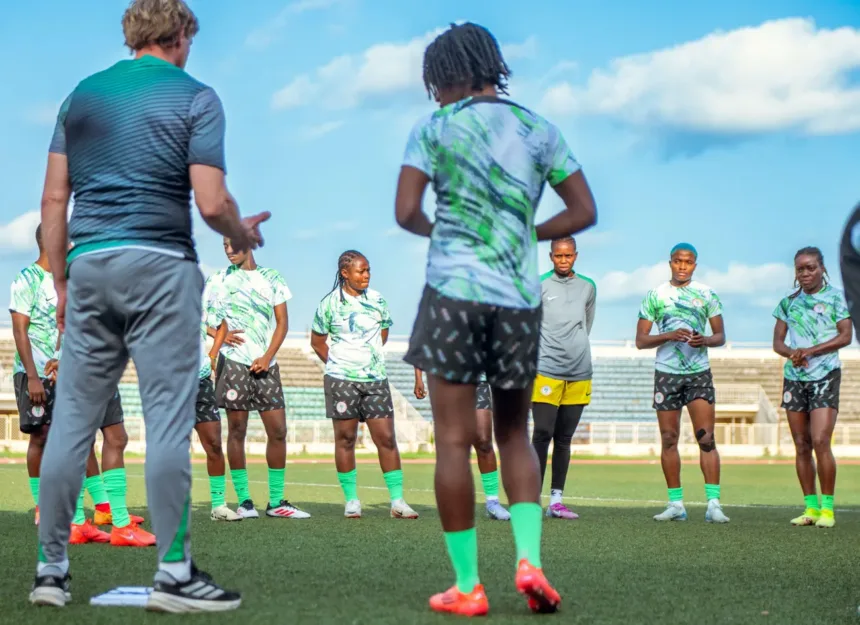
Nigeria's Super Falcons, the most decorated national side in Africa, will miss the Women's World Cup for the first time after a 2-1 playoff defeat to South Africa in Casablanca in August.
The loss ends a run in which Nigeria was one of only seven teams to have played at every Women's World Cup, and the only African team on that list. Next year's tournament will be held in Brazil.
Nigeria was pushed into the playoff only days after Cameroon knocked it out of the Women's Africa Cup of Nations at the quarterfinal stage. Only the semifinalists qualified for the World Cup automatically.
The absence carries a financial cost. Nigeria will miss out on developmental funding as the tournament's prize fund is expected to grow from four years ago, though FIFA appears set to fall short of President Gianni Infantino's 2023 pledge to match the men's and women's prize funds by 2027.
Preparation and pay disputes
Janine Anthony, a journalist who covers African women's football, says the team has long been treated as an afterthought in domestic league planning, management and preparation. She argues that a shortage of warm-up matches left the side lacking cohesion in Morocco.
Before the continental tournament, Nigeria played only two games, both against Senegal, a team that has never reached a World Cup. Ahead of the 2025 edition, the Super Falcons had three friendlies, against France, Cameroon and Portugal. Then-coach Justine Madugu frequently changed his starting lineup during the tournament.
The Nigerian Football Federation absolutely failed to capitalise on the Wafcon being moved to July.
Janine Anthony, African women's football journalist
Money has been a recurring flashpoint. Players and coaches have protested unpaid allowances and bonuses for years, and the Super Falcons staged sit-ins and training boycotts at the continental championships in 2004, 2016 and 2022 and at the 2019 World Cup.
The Nigerian Football Federation is under investigation by the country's Department of State Services over the alleged misuse of a 17 billion naira fund the government issued in 2024 to settle money owed to national team players and staff. The federation did not comment on the accusations.
Leadership turmoil at the federation
Nigerian President Bola Tinubu said in August that the country's football needed sweeping changes in governance, administration, player development, domestic competitions and accountability.
Nigerian football must undergo far-reaching changes to strengthen governance, administration, stakeholder representation, player development, domestic competitions and accountability
Bola Tinubu, president of Nigeria
Shortly afterward, Ibrahim Gusau resigned as federation president, along with several other board members.
Federation elections planned for September were suspended. They are now expected to follow reforms drawn up in consultation with FIFA and the Confederation of African Football.
A shifting map in Africa
The women's setback adds to wider struggles. Nigeria's men's team has failed to qualify for two straight World Cups, and the under-17 men have not reached a World Cup since 2019.
Elsewhere in Africa, Morocco is the only country from the continent that played at the 2023 World Cup to be guaranteed a place next year. South Africa heads to intercontinental playoffs starting this month, while Malawi, which made its continental tournament debut, will play at its first World Cup.
Cameroon won the continental title after qualifying only because the Confederation of African Football expanded the field from 12 to 16 teams.