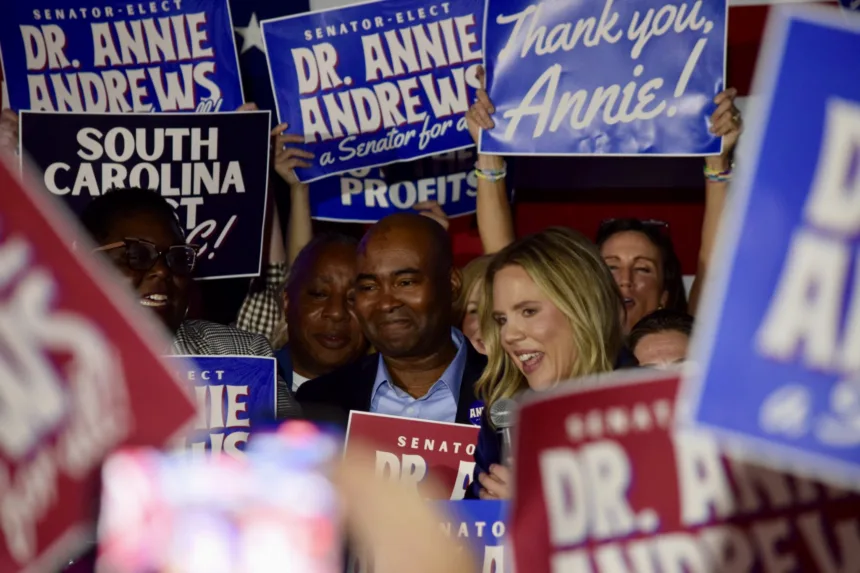
Democrat Annie Andrews won South Carolina's U.S. Senate seat with help from Republicans and independents who split their tickets, an analysis of election data shows. She is the first Democrat the state has elected to the Senate since 1998.
Unofficial results give Andrews 51% of the vote, 4.5 percentage points ahead of Republican Sen. Darline Graham, a gap of more than 91,000 votes. Graham had held the seat for about three months after being appointed to finish the term of her brother, Sen. Lindsey Graham, who died in July at 71.
The clearest sign of crossover came from the governor's race. Republican Attorney General Alan Wilson won it by the same 4.5-point margin, yet he drew a larger share of the vote than Graham in every county. Because South Carolina voters do not register by party, that gap points to Republicans choosing Andrews.
Seven counties backed Wilson for governor and Andrews for Senate: Barnwell, Calhoun, Clarendon, Colleton, Greenville, Jasper and York. Andrews outpolled Graham in 25 of the state's 46 counties, including Greenville and York, long Republican strongholds.
Trump and a GOP feud
President Donald Trump, whose encouragement and endorsement prompted Graham to run, rallied for her twice in 10 days and told supporters to act as if he were on the ballot. She still ran behind his 2024 share in every county, falling at least 10 points short in 30 of them.
The steepest drop came in Spartanburg County, which Graham carried by a margin 15.3 points smaller than Trump's. Kershaw, Graham's home county of Lexington, and Berkeley each slid by more than 13 points. Trump won the state by nearly 18 points two years ago.
Part of the split traces to a Republican feud over Graham's nomination. Many Republicans saw Trump's backing as interference, particularly supporters of U.S. Rep. Ralph Norman, who lost to Graham in an Aug. 25 runoff. Norman said he would vote for her but refused to campaign with her, and his son, Warren Norman, endorsed Andrews.
A write-in push for Norman fizzled. Fewer than 4,900 voters wrote in any name, according to uncertified state Election Commission figures, and the Libertarian and Constitution candidates together drew under 40,400 votes, too few to change the outcome.
Turnout and rural shifts
About 2 million of the state's 3.4 million registered voters cast ballots, a 60% turnout, according to the state Election Commission, topping the non-presidential-year record set 24 years ago by 5 points. More than 1 million voted early, nearly double the 562,000 early votes cast in 2022.
Rural voters mattered too. More than 138,000 backed Andrews, who won 51% in nonmetropolitan counties, many in the majority-Black communities of the Black Belt, according to an analysis of preliminary data. Clarendon County, which Trump carried by 12 points in 2024, went for her by 6.
State Democratic Party officials credit door-to-door work. State Director Jay Parmley said the party made 6 million attempts to reach voters since the June primaries, with 750 volunteers knocking on doors in the final two weeks. Democrats also flipped 10 state House seats, erasing the chamber's Republican supermajority.
Political science professors around the state cite Democratic enthusiasm, anger over the Iran war and high prices, Andrews' focus on affordability, and voter dislike of Graham inheriting her place on the ballot. Andrews called for suspending state and federal gas and diesel taxes and campaigned against data center development.
Take one lackluster candidate, one great candidate, one terrible economy, one big GOP family fight and mix well.
Scott Huffmon, Winthrop University professor and Winthrop Poll director
The wave had limits. No other statewide office changed parties, and University of South Carolina political scientist Shannon Bridgmon said the state is more pale red than purple for now, with its future depending on whether Democrats can repeat their momentum.