

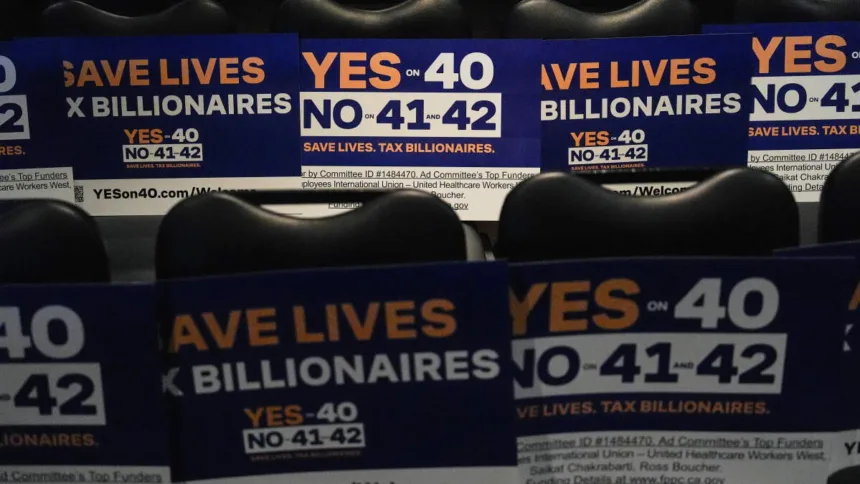
California voters have defeated Proposition 40, a one-time 5% tax on most of billionaires' wealth that supporters said would raise $100 billion for healthcare. The measure lost 52.8% to 47.2%, so California will not become the first state to tax the wealth of its richest residents.
The proposal had trailed for days before the outcome was confirmed Monday. Leaders of the union behind it, Service Employees International Union-United Healthcare Workers West, appeared to concede minutes before polls closed, but pledged another attempt in 2028 if the Legislature does not produce a real plan to fund healthcare strained by recent federal law.
The fight was lopsided financially. Ultra-wealthy opponents gave $378.4 million to defeat the tax, while the Yes campaign raised $33.5 million.
Google co-founder Sergey Brin led that spending. He publicly moved out of state and gave $102 million to Building a Better California, a committee he founded that also channeled money from other billionaires and funded two counter-measures, Propositions 41 and 42.
Those measures could shape what comes next. Proposition 42, which would ban future wealth taxes in California, led 51.6% to 48.4% Monday evening, a result that could block the union's plan to try again.
The tax exposed a rift among Democrats, who heavily outnumber Republicans in the state. The California Democratic Party, the California Federation of Labor Unions, Rep. Ro Khanna and Sen. Bernie Sanders backed it.
Gov. Gavin Newsom was among its earliest opponents. He tried through backroom talks to keep it off the ballot, endorsed Proposition 42 and said a national tax on the wealthy would be preferable. Democratic gubernatorial candidate Xavier Becerra, the California Teachers Association and Planned Parenthood of California also opposed it.
Supporters argued that the Republican-controlled Congress had cut healthcare to pay for tax breaks for the rich, and that federal cuts are expected to push 2 million Californians off health insurance. Opponents countered that a one-time levy would not fix the state's finances and would drive wealthy residents, and their tax revenue, out of California. The state has more than 200 billionaires by some estimates, and several hundred by others.
After the loss, union president Dave Regan blamed the spending gap, calling billionaire money corrosive to democracy. Lorena Gonzalez, president of the California Federation of Labor Unions, said the defeat raises pressure on state and federal lawmakers to backfill federal Medicaid cuts.
The No campaign called the measure a reckless experiment on the state's economy, while acknowledging the state still faces enormous pressure to fund healthcare hit by federal cuts.
Late polling pointed to the outcome. A UC Berkeley Citrin-POLITICO survey found 45% of voters favored taxing billionaires more to fund public services, against 35% who prioritized keeping them in the state, yet only 46% backed Proposition 40. USC economist John Matsusaka said before the election that Democratic infighting could hurt the measure, arguing money can exploit voter uncertainty.
People these days are very tribal. When your tribe is arguing, people start to listen to the counterarguments,
John Matsusaka, USC economist and direct democracy expert
Election Day went badly for the union in other ways, too. Voters also defeated its Proposition 44, which sought to control how clinics spend money.