
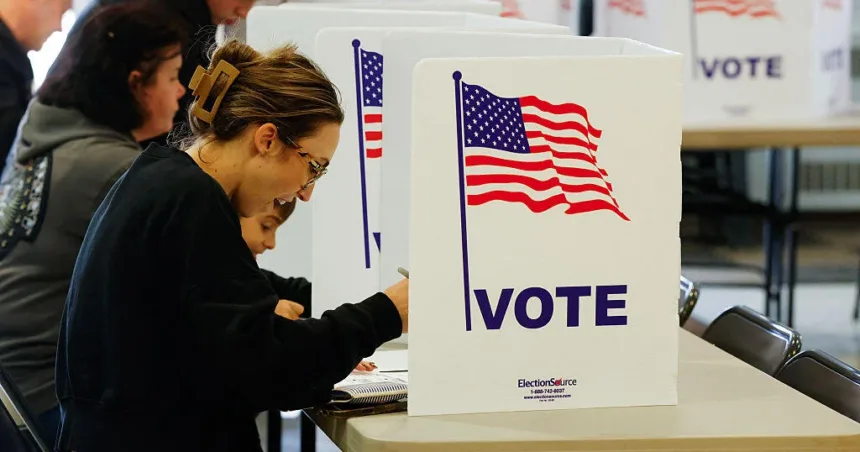
Americans who expect to learn which party controls the House and Senate on Tuesday night may not be settled on election night, as tight contests, slow-counting states and ranked choice tabulations in Alaska and Maine could push the answer into Wednesday or several weeks beyond.
Republicans are defending narrow majorities in both chambers, while Democrats are trying to take power in Washington for the last two years of President Donald Trump's term. Public polling favors Democrats in the House and in several key Senate contests.
Senate hinges on eight races
Senate control is likely to hinge on eight races: toss-ups in Alaska, Iowa, Kansas, Ohio and Texas, plus contests leaning Democratic in Maine, Michigan and New Hampshire. Even if Democrats keep Georgia and flip North Carolina, they would still need five of those eight.
Iowa, Kansas, Ohio and Texas tallied ballots quickly in 2024, and more than 80% of their vote is expected to be in by midnight Eastern time. Yet a Democratic sweep of all four would still leave the party short of a majority.
Michigan and New Hampshire run elections through towns and municipalities rather than counties, a patchwork that can keep counts going until early or midday Wednesday. In Michigan, Detroit's Wayne County tends to report huge tranches of ballots after midnight, and statewide races there frequently cannot be called until those numbers arrive.
Alaska and Maine count most slowly. Alaska accepts mail ballots from remote areas up to 15 days after the election, and if no candidate wins a majority, its ranked choice tabulation happens 15 days after Election Day; Maine released ranked choice results 10 days after its June primary. In 2024, the presidential race was not called in Maine until Wednesday afternoon and in Alaska until Thursday morning.
House margin sets the clock
Ranked choice voting also applies to House races in both states, so a majority that depends on Maine's 2nd District or Alaska's single district could wait 10 to 15 days.
Democrats need a net gain of only three seats to win the House, where 218 of 435 seats are required for control. If either party's majority ends up in single digits, reaching 218 could take days or weeks; after the 2022 midterms, eight days passed before a Republican majority was projected.
Glitches at the polls
Early clues may come from Kentucky's 6th District, where polls close at 6 p.m. Eastern and Trump won by 15 points in 2024, pitting Democrat Zach Dembo against Republican Ralph Alvarado. Florida, which counts fast, offers the 25th District, redrawn to favor Trump by 9 points, where Democratic Rep. Jared Moskowitz faces Republican Scott Singer.
In New York's Westchester County, most polling sites could not scan ballots Tuesday. The state Board of Elections blamed a late programming change to one municipality's contest that never reached Election Day machines elsewhere, and said voting was continuing under emergency ballot procedures. Parts of the county sit in the competitive 17th District, where Republican Rep. Mike Lawler faces Democrat Cait Conley.
Fulton County, Georgia, reported two separate machine problems at two polling sites involving about 1,000 early-voting ballots, including persistent paper jams and a power issue. Secretary of State Brad Raffensperger said he did not expect results to be delayed.
Election expert David Becker, who leads the Center for Election Innovation & Research, doubts Americans will know who controls the House or Senate on election night. Experts warn that slow calls in close races are routine and do not signal fraud, despite what some candidates may claim.
If we do, then there's a very big wave going on,
David Becker, Center for Election Innovation & Research
House Speaker Mike Johnson has insisted the polls are wrong, telling a Virginia rally Monday night that he expected House control to turn on roughly 21 seats.