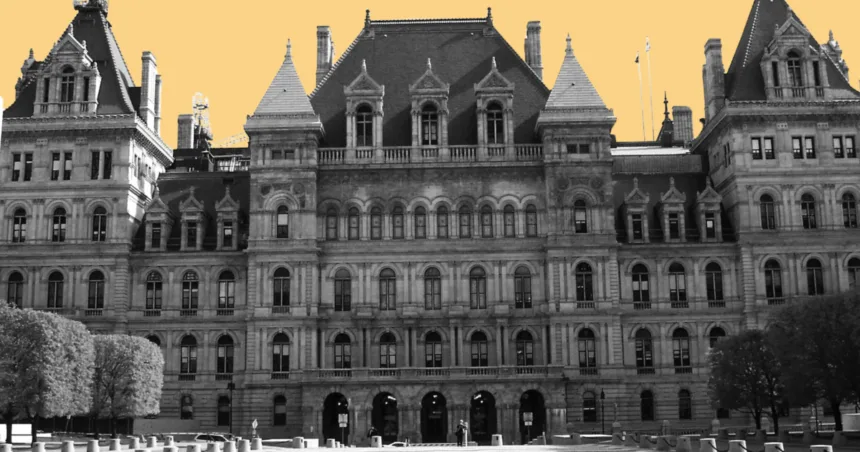
New York Democrats will control veto-proof supermajorities in both chambers of the state legislature after flipping more than a dozen Republican-held seats on Tuesday, tightening the party's hold on Albany.
The Senate gains restore a supermajority Democrats lost after 2024. Assembly Speaker Carl Heastie says the party's expected 111 seats would be its most ever in the 150-member chamber.
The legislative wave rolled in alongside Gov. Kathy Hochul's commanding re-election and Cait Conley's victory over Mike Lawler in a congressional race.
Democrats picked up at least six Senate seats and at least seven Assembly seats previously held by Republicans. Three more contests remained uncalled as of Thursday afternoon, and each could add to the Democratic total.
In Central New York, Democrat Ian Phillips holds a lead that appears nearly impossible for Republican Assemblymember John Lemondes to overcome. Out in Erie County, the GOP incumbent, Patrick Chludzinski, was behind his Democratic challenger, Ryan Taughrin.
The tightest of the three is in the Capital District, where Republican Sen. Jake Ashby held a 177-vote edge over Democrat Devin Lander, with thousands of mail ballots still to be tallied.
Republicans managed a single pickup. Michael Gentile won a Mohawk Valley Assembly district covering Utica and Rome by 5 points over Democrat Jonathan Lipe, in a seat left open by the retirement of Democrat Marianne Buttenschon.
Veteran Republicans ousted
Several prominent Republicans lost. Jim Tedisco, the longest-serving sitting member of the legislature, was defeated in his Saratoga-area Senate district by Sarah Rogerson, closing out 44 years as a lawmaker.
In South Brooklyn, Alec Brook-Krasny lost a rematch to Chris McCreight, one of four seats Democrats took from Republicans in the borough.
Winners credited the national climate. Joe Rand, who beat Republican Sen. Bill Weber in a Rockland County district Trump carried by 11 points, said any Democrat had a strong year. Christopher Murray, who unseated Sen. Anthony Palumbo on Long Island's East End, said he had never encountered such anger at one party while canvassing.
Limits of a supermajority
On paper, the new margins let lawmakers override Hochul's vetoes. But neither Heastie nor Senate Majority Leader Andrea Stewart-Cousins has signaled interest; the legislature has not overridden a governor since it rebuffed Republican George Pataki on budget measures in 2006, and Heastie has called an override a nuclear option.
State Sen. James Skoufis, who clashed with Hochul last year before patching things up, said the balance of power with the governor stays the same. Larger majorities could still give legislators more leverage at the negotiating table.
A bigger conference brings its own strains. Discretionary budget money that members steer to their districts may be spread thinner, and Rand noted that committee chairmanships are limited.
Turnover will be steep: at least 51 newcomers, nearly a quarter of the 213-member legislature, double the 24 freshmen elected in 2024. Senate Deputy Leader Michael Gianaris and Assembly Majority Leader Crystal Peoples-Stokes are retiring, and Senate Finance Chair Liz Krueger, recovering from a spring stroke, has suggested she may take a different role.
An ideological tug-of-war
The Working Families Party's endorsed members will rise from 28 to 34 in the Senate and from 52 to 65 in the Assembly, outnumbering Republicans in each chamber. Lawmakers backed by the Democratic Socialists of America will grow from 9 to 16.
You’re going to have the DSA tail wagging the Democratic dog
John Faso, former Republican congressman and Assembly minority leader
John Faso, a former Republican congressman and Assembly minority leader, expects the socialists to steer the conference as their push to tax the wealthy takes center stage in 2027. Skoufis countered that a larger DSA bloc may push Hochul toward balance, while Samantha Kattan, a DSA member elected to Claire Valdez's Queens Assembly seat, said even moderate winners support taxing the rich.