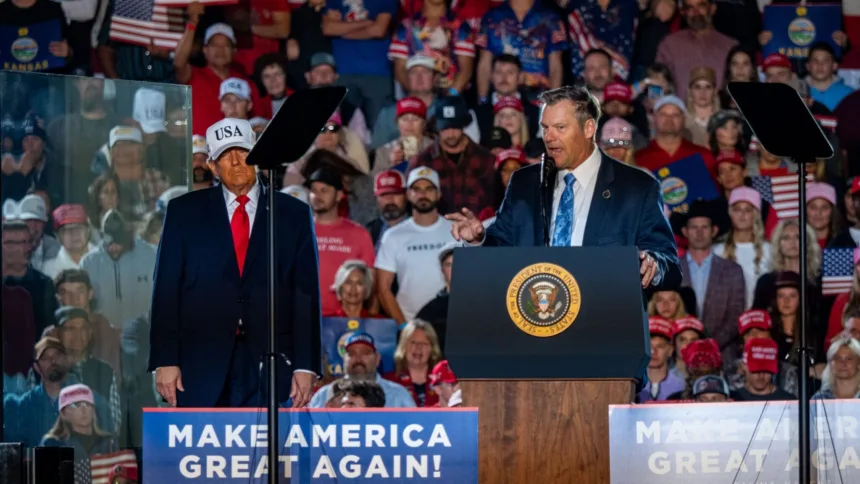
President Donald Trump said he would accept the results of Tuesday's midterm elections, in which Democrats won control of both the House and Senate, a sharp break from his long record of claiming that losses were stolen.
Democrats held 54 Senate seats as of midday Wednesday and had captured at least 228 House seats, comfortably more than the 218 needed for a majority.
In a string of interviews late Tuesday, Trump congratulated Democrats and raised the prospect of striking deals with them, though he did not take responsibility for the Republican defeat. He blamed it on not being on the ballot himself, despite having urged supporters to vote as though he were.
Vice President JD Vance pointed instead to the war with Iran, writing on social media that many people who backed the Trump-Vance ticket in 2024 had switched to Democrats this year.
The midterms were Trump's first election as a sitting president since 2020, when his drive to reverse his defeat fed into the mob attack on the Capitol on Jan. 6, 2021.
David Becker, who leads the Center for Election Innovation & Research, said the lopsided fight for Congress and heavy turnout left no room to contest the outcome.
A season of legal fights
The quiet acceptance followed months in which election officials braced for federal interference. After the FBI seized 2020 ballots from Fulton County, Georgia, in January, state and local leaders drew up plans for how poll workers should respond if federal agents arrived, and some states added new limits on law enforcement and troops at polling places.
Voting rights advocates said the administration did try to shape how states ran the vote. The Justice Department sued California over ballots from 20,000 suspected noncitizens, a demand state officials warned would cause chaos; the Supreme Court rejected it Monday. A federal judge threw out a separate suit against Alaska, over alleged voter confusion in its Senate race, on Sunday.
The department's lawsuits seeking unredacted state voter rolls fared no better. Federal judges have ruled against it in at least 27 decisions, and the administration has not won any of those cases.
Judges also found that election-related field operations run by the Department of Homeland Security could intimidate voters. Democrats and election experts said the agency's new software for flagging possible noncitizen voters was unreliable and prone to mislabeling citizens.
Trump's push for Republican-friendly congressional maps did little to protect GOP candidates in Alabama, North Carolina, Texas and other states. The Supreme Court blocked his effort to have the Postal Service restrict mail ballots, and Congress did not pass the SAVE America Act, which would have imposed immediate proof-of-citizenship rules on voters.
Despite unprecedented executive branch efforts to interfere in election administration, state and local officials responsible for running our elections have continued to do their jobs and uphold the process
Michael McNulty, senior policy director at Issue One
Pressure may not be over
Late on Election Day, the Justice Department won a rare ruling when the 9th Circuit Court of Appeals affirmed a three-judge panel's decision lifting limits on the administration threatening election workers with prosecution. A federal judge in California had barred such threats of criminal charges only last week.
Department lawyers have also floated prosecuting officials who count noncitizen ballots or skip federal recordkeeping rules, and they subpoenaed election workers in Los Angeles County for records that suggest prosecutors are examining whether officials helped noncitizens vote.