

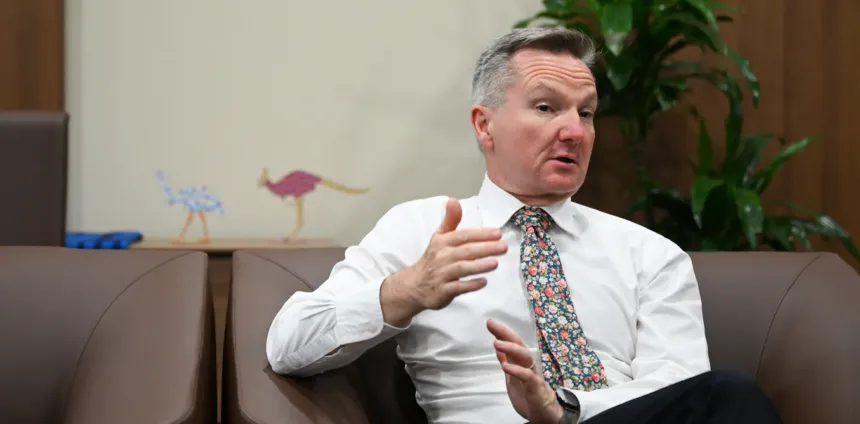
Australian Climate and Energy Minister Chris Bowen is defending Prime Minister Anthony Albanese against widespread criticism that his speech at the COP31 climate summit in Turkey left out any mention of fossil fuels.
Bowen called the address a very strong and very clear call for climate action. He also noted that the call to transition away from fossil fuels in energy systems, adopted at the COP28 summit in Dubai in 2023, was an Australian suggestion.
The omission drew attention because of its timing. Only minutes before Albanese spoke, UN Secretary-General António Guterres urged countries to make coal, oil and gas go the way of the dinosaurs. Bowen is serving as chief negotiator at the summit in Antalya, which Australia is co-hosting with Turkey.
Plans, roadmaps and exports
Guterres and leaders from Brazil, Germany, the Netherlands and other countries want nations to draw up roadmaps for shifting their energy systems off fossil fuels. Asked whether Australia should produce one, Bowen pointed to the country’s national net zero plan, which lays out a path to net zero emissions by 2050, and said such plans could just as easily be called roadmaps.
He described Australia’s targets as ambitious and achievable. The country is the world’s second-largest exporter of coal for power stations, the largest exporter of coal for steelmaking, and the source of a fifth of the world’s exported liquefied natural gas.
Australia is on track for its 43% emissions cut by 2030. Current policies, however, fall far short of what its 2035 goal of a 62% to 70% reduction would require.
Electrification and carbon capture
Australia and Turkey have launched a “35-by-35” electrification pledge and are urging other countries to sign on, though it does not say how much of that power should come from renewable sources. Bowen said almost all electrification is good, since electrifying anything cuts emissions, even if it works best alongside a large renewable buildout.
Electricity currently makes up about 23% of the energy mix and has been growing by 0.3% a year, Bowen said, adding that at that pace there is no chance of holding warming to 1.5°C.
The world is expected to overshoot 1.5°C within the next three years, leaving any return below that line dependent on emissions cuts and massive carbon removal. Bowen said overshoot puts more options on the table and described his approach to carbon capture and storage as pragmatic, but said it is expensive, not the answer and no substitute for direct emissions cuts. About 77 such facilities operate worldwide, capturing roughly 0.01% of humanity’s emissions.
You can’t just say, ‘Oh, well, we’ll keep warming, and eventually, direct air capture will sort it out’.
Chris Bowen, Australian climate and energy minister
Bowen defended the summit process as well. He acknowledged it had not stopped warming above 1.5°C, but said the world was headed for more than 4°C when the Paris agreement was struck and is now on course for 2.6°C.
On fossil fuel lobbyists, whose attendance figures are due within days after about 1,600 came to COP30 in Brazil last year, Bowen said an open summit cannot bar them. He said only ministers negotiate and no lobbyists are in the room.
He also said the U.S.-Iran conflict and soaring fuel prices had made the reliability of renewable energy starker for many Australians over the past six months.