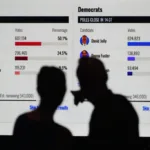


The Senate voted 73-25 on Monday to advance a bipartisan bill to speed permitting for big energy projects. The vote gives the outgoing Republican-led Congress a chance to reshape how the country approves infrastructure before Democrats take over.
The cloture vote on the Bipartisan American Affordability and Jobs Act of 2026, known as BAAJA, cleared only the first of several procedural hurdles. Republicans carried it less than a week after Democrats' sweeping midterm victories, and Democratic incumbents split over the measure.
Final passage is far from certain. Some Democrats who voted to limit debate want to amend the bill to protect Native American tribal nations' say over projects affecting their lands, but any change risks losing Republican votes. The bill must also clear the House, where Republicans hold a slimmer majority and Minority Leader Hakeem Jeffries has already voiced opposition.
President Donald Trump added another complication. Speaking at an impromptu news conference while the vote was underway, he said he would not approve wind turbines, even as he praised the legislation as a bipartisan bill.
Sen. Sheldon Whitehouse of Rhode Island, the bill's co-author and the ranking Democrat on the Senate Environment and Public Works Committee, warned afterward that Democrats could withdraw their support. He said the bill's success depends on the administration getting wind turbines running, and that more progress is needed before final passage.
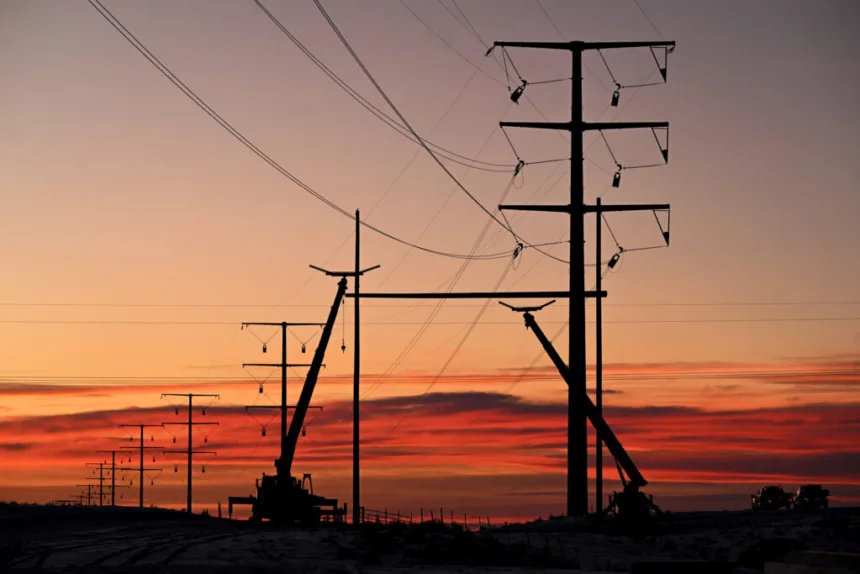
Backers say the measure would cut through rules that have piled up over 70 years. High-voltage transmission lines, which deliver clean power, take 10 years on average to build, and the need has grown more urgent as electricity demand climbs, partly because of artificial intelligence data centers.
The Center for Climate and Energy Solutions estimates the bill would save $2.5 billion a year on residential electricity bills. Its authors also included provisions requiring new data centers to cover their own energy costs.
Labor unions and the clean energy industry broadly support the bill. Sen. Martin Heinrich of New Mexico, a co-author and the ranking member of the Senate Energy Committee, said it would create more than 100,000 trades and manufacturing jobs, while acknowledging it is not perfect.
Sen. Jeff Merkley of Oregon, in line to chair the Environment and Public Works Committee next year, voted no. He argued the bill could ease construction of data centers powered by on-site natural gas plants and of pipelines carrying gas for export, potentially raising greenhouse gas emissions.
Getting more renewable electrons where they are needed doesn’t tackle climate change if you simultaneously promote the burning of more fossil fuels
Sen. Jeff Merkley (D-Ore.)
Many environmentalists had hoped the bill would fall short of 60 votes so the larger Democratic majority in the next Congress could rewrite it. Supporters pushed for a lame-duck vote, doubting that a Democratic-led Congress could produce a bill Trump would sign. The Environmental Defense Fund and Evergreen Action broke with most green groups to urge support.
Before the vote, the co-sponsors amended the legislation to address critics. The changes revised permit certainty provisions that limit federal power to stop a project after initial approval, doubled a look-back period used to judge arbitrary treatment from five years to 10, and responded to tribal concerns under the National Historic Preservation Act.
Earthjustice said the amended bill offers some meaningful improvements but still gives the Trump administration broad authority to fast-track harmful projects. Democratic Sens. Catherine Cortez Masto of Nevada and Brian Schatz of Hawaii want further changes, and New Mexico Governor-elect Deb Haaland remains opposed.