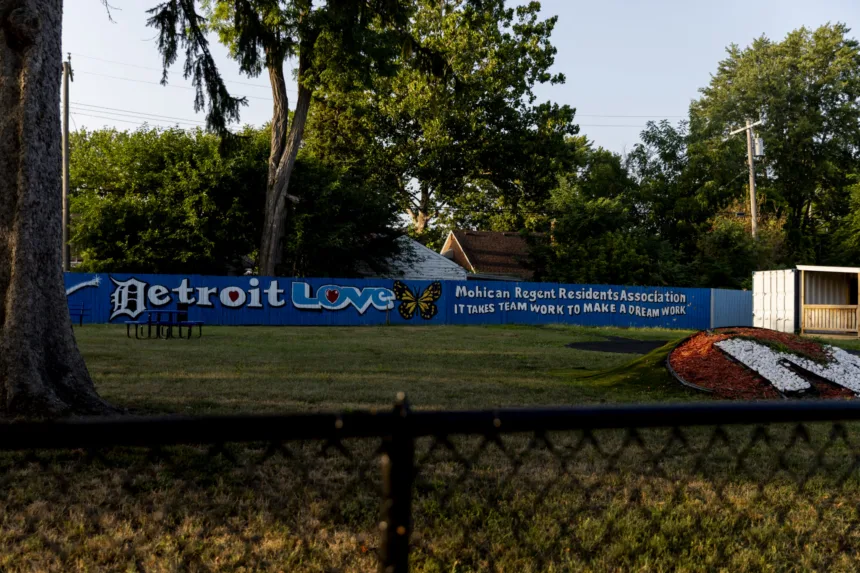
Homicides fell 33 percent over three years in six Detroit zones where community groups design their own anti-violence strategies, compared with 12 percent across the rest of the city, a University of Michigan evaluation of the city's ShotStoppers program has found.
Nonfatal shootings dropped 38 percent inside the zones and 28 percent outside them. The researchers stopped short of saying the program caused the steeper declines, but co-author Sam Stragand, a senior program manager at the university's Poverty Solutions, said the teams appeared to have significant influence in their areas.
The results come as Detroit sees record declines in gun violence and as the city pushes to turn the program, which has received more than $11 million over three years, into a permanent public safety strategy.
Groups set their own tactics
Launched in 2023, ShotStoppers has no connection to the ShotSpotter gunshot detection system. What sets it apart from other city-backed intervention efforts is how much freedom each group has to decide how to prevent shootings, along with extra funding for groups whose zones beat citywide trends.
Mike Peterson, the program's director, said the groups know their neighborhoods better than anyone in the mayor's office or any police officer, and that the substance of the work should rest on their autonomy, relationships and capabilities.
The resulting approaches differ sharply. Force Detroit, on the West Side, concentrates on people actively involved in shootings, while New Era, in the Northwest, leans on community engagement, local events and resources for residents. Stragand called Force Detroit by far the best performer but said New Era also posted significant decreases.
The east side has long been among the city's hardest-hit areas. In the 48205 zip code alone, 732 people were shot between 2017 and 2024, including 151 who were killed.
There, Team Pursuit, run by Quincy Smith, relies on credible messengers with firsthand experience of longstanding conflicts, including a Bloods-Crips feud that escalated in the late 2000s, to step in before disputes turn violent. Nonfatal shootings in its zone fell from 65 in the program's first year to 19 in its second.
Funding still a question
ShotStoppers began with pandemic relief money and now draws on the city's general fund, with some state support. The City Council approved an additional $3 million for the 2025-2026 fiscal year, and the adopted 2026-2027 budget includes $10.8 million for community violence intervention, up $3.4 million. About $2.6 million in state public safety funding has also been set aside to expand the work.
Peterson said the program is not yet considered a guaranteed part of the city budget, though nothing clearly signals the money is at risk. He said the goal is to move it from a pilot to a standing public safety function, which will take time.
You can only hold the peace for so long when the underlying factors don’t change
Sam Stragand, University of Michigan Poverty Solutions
Even with a lasting commitment, Stragand cautioned, the groups operate in neighborhoods facing disinvestment, limited economic opportunity and social problems they cannot fix on their own.