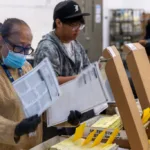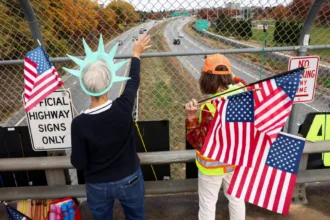

Voters in Alaska and Maine ranked their choices Tuesday in two closely contested Senate races that could help decide control of Congress. Because of the voting method, final winners may not be clear for days or even weeks.
The two states are the only ones using ranked choice voting to pick a U.S. senator this election. Both races are rated as toss-ups.
How the count works
Under the system, a candidate who wins more than 50% of first-choice votes is the winner. If no one clears that bar, the last-place candidate is dropped and those ballots move to each voter's next choice, a process that repeats until someone has a majority.
Ranked ballots alone do not slow results, election experts say, but they can add time. In Alaska, the rankings are not tabulated until after the final ballot count 15 days after Election Day, so a race without a first-round majority could stretch on for weeks.
Unless a candidate gets a majority with first choices alone, we can't be confident in who the winner is going to be until the ranked choice voting tabulation happens
Derek Tisler, elections expert, Brennan Center for Justice
Alaska counts mail ballots that arrive up to 10 days after the election, or 15 days in some cases, because of its size and the many voters who live in places reachable only by plane or boat. In a close Senate race, it could take up to two weeks before enough votes are counted to confidently predict a winner. State officials are aiming to certify results on Nov. 25.
Maine faces its own logistical hurdle. Its ranked choice tabulation must happen in Augusta, the state capital, so ballots and memory devices from across the state have to be transported there first.
Longer waits for results are not a delay in the process. There's nothing wrong when that happens
Wren Orey, managing director, Bipartisan Policy Center's Elections Project
A crowded Alaska ballot
Alaska voters face four names: Republican Sen. Dan S. Sullivan, the incumbent; Democrat Mary Peltola; Republican Gerald Heikes; and Daniel J. Sullivan, a retired teacher with nearly the same name as the senator. Heikes joined the ballot after Democrat David Leslie, who placed fourth in the primary, withdrew.
In the August open primary, Peltola took 49.5% of the vote and the senator took 41.4%. Daniel J. Sullivan won 2.5%.
The sample general election ballot lists the senator as a registered Republican and the incumbent, while Daniel J. Sullivan's name appears with no identifiers. The state supreme court let him stay on the ballot after a summer legal fight over his eligibility.
Daniel J. Sullivan's candidacy is now the subject of a federal criminal investigation over allegations that operatives connected to Peltola's campaign recruited him to undercut the senator. Peltola has denied any knowledge of the effort.
The Justice Department sued to block Alaska officials from certifying the Senate result if the senator loses to Peltola, but a federal judge dismissed the case Sunday, finding the federal government lacked the legal right to sue. The department has said it will appeal. President Trump called Daniel J. Sullivan a fake candidate in a social media post early Tuesday.
Maine's race and the history
In Maine, voters can rank Republican Sen. Susan Collins and Democrat Troy Jackson, or write in one of six official write-in candidates. Voters in both states may rank as few candidates as they like.
Maine adopted ranked choice voting through a 2016 ballot initiative and first used it in 2018. Alaska voters approved it in 2020, first used it in 2022 and kept it through a 2024 ballot measure.
Alaska's first experience shows how long a count can run. In a 2022 special House election, Peltola won a majority in results that came 15 days after Election Day, and later that year she secured a full term on Nov. 30 after rising from 48.8% to 55% in the second round.