
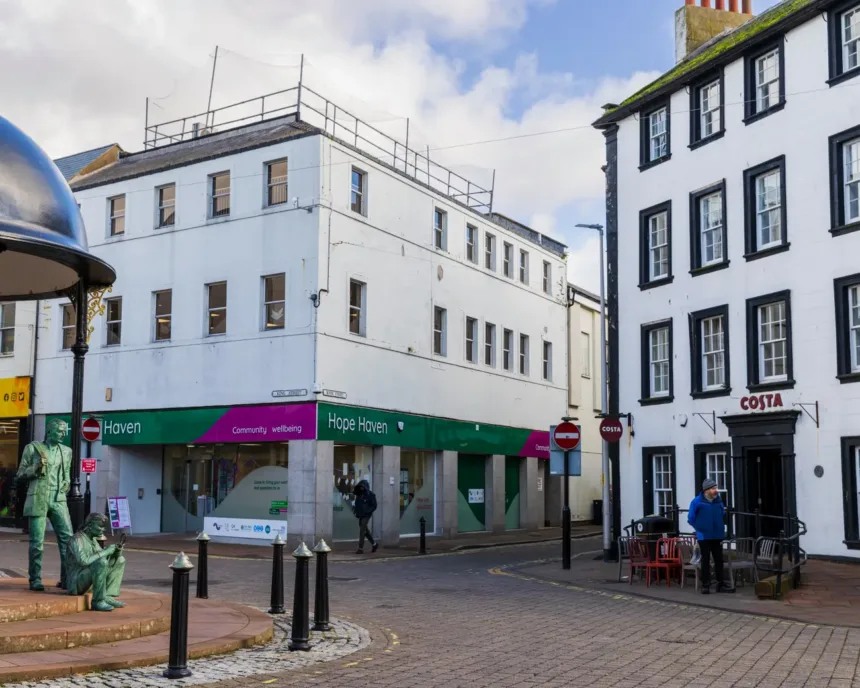
A round-the-clock mental health hub in Whitehaven, on England's far northwest coast, is reaching people the NHS had never seen. In this analysis, its early numbers make a strong case for watching the national rollout closely rather than rushing to a verdict.
Hope Haven is one of six pilot hubs in England. It stays open day and night and asks no one for a referral or a diagnosis. About 3,000 people used it in person or online during its first five months, March through July, and close to half had no prior contact with NHS mental health services.
In the same area, admissions to inpatient mental health wards dropped 24% from January to September compared with those months a year earlier. That is one local figure over a short span, not a controlled study, and an evaluation of the pilots is due later this year.
Why Whitehaven matters
The town's need is stark. NHS Alliance puts the local suicide rate at 20 per 100,000 people, nearly twice the national rate, and referrals to local mental health services have tripled since 2017.
Staff tie the strain to economic decline. Vikki Ford-Powell, who works at the hub, links lost hope to the closure of factories and large employers, while colleague Sue Papworth says pockets of deprivation belie the wealthy image of the nearby Lake District.
Josh MacAlister, the Labour MP for Whitehaven and Workington, has praised the center, calling its early signs positive and noting that asking for help is hard in a close community where services are far away.
Having a walk-in, low-stigma service that offers a range of help could prove to be a big part of the solution.
Josh MacAlister, Labour MP for Whitehaven and Workington
A model built beyond therapy
The design borrows from the Trieste model, a 24-hour holistic approach that began in Italy in the 1980s. Beyond mental health care, the hub brings exercise classes, financial advice and housing support under one roof, along with a few short-stay beds for overnight help.
Users describe that breadth. Tamara, 22, was dropped off by a friend late one night and was seen at once, then booked for the next day. Gordy, 47, says one-to-one support let him stop antidepressants after four and a half years. Mary Bragg, 91, a widow, comes for a weekly chair-based exercise class and has made friends there.
Suicide’s massive around here, and this is direct, 24 hours a day, seven days a week.
Gordy, Hope Haven user
The stakes of scaling up
The stakes now reach well past Cumbria. The remaining pilots operate in Sheffield, York, Birmingham and two London boroughs, Lewisham and Tower Hamlets. Andy Burnham has announced £343m for a sweeping overhaul of mental health services, with 100 more hubs set to open in stages starting this autumn.
Personal testimony and a months-long dip in admissions cannot prove the approach works. But drawing in people who never entered the system is exactly where traditional NHS services have struggled, and the coming evaluation, not early enthusiasm, should decide how far the model spreads.