Hackers hijacked Ukraine's Air Alert app late Sunday and pushed false warnings of nuclear and chemical danger to users in Kyiv and other areas. Hours later, Russia said its own emergency ministry app had been breached, as a rare local ceasefire in the Kherson region was ending.
Officials in neither country said who was responsible, and it was unclear whether the two attacks were connected. A Russian Telegram channel said a hacking group called Hitcore had claimed the Ukrainian breach, a claim that has not been independently verified.
The bogus Ukrainian messages started around 10:45 p.m. Kyiv time. They told residents to stay indoors because of radiation, a chemical threat and street fighting, and one, in Russian, declared the whole country under nuclear alert while invoking Russia's Oreshnik missile. Other texts mixed Russian and Ukrainian or used error-filled English.
Ukraine's air force said the app had likely been compromised by the enemy, insisted there was no radiation threat and switched off push notifications. The app's developers said outsiders had interfered with it, later labeled the incident a cyberattack and began restoring service. By Monday, the state emergency service said the national alert system was working normally.
The disruption spread beyond phones in the western Lviv region, where officials said some public sirens and loudspeakers broadcast a radiation hazard signal. Yurii Ihnat, an air force spokesman, said the breach did not affect security or defense operations because the app is separate from military command systems.
Many Ukrainians brushed off the warnings, in part because they arrived in Russian rather than Ukrainian. Oleksander Merezhko, who chairs the Ukrainian parliament's foreign affairs committee, said the hack caused no panic. Still, a Kyiv resident named Olena said her first reaction was fear, explaining she had prepared for blackouts and heating cuts but not a nuclear strike.
Russia reports its own breach
Russia's Emergency Ministry said intruders who got into its app sent a false alert at about 2:45 a.m. Moscow time that reached 33 regions out of the country's 89. Screenshots suggested the message warned of nuclear warheads fired at Russia, and some of the fake alerts used foul language.
The ministry said it had found the weakness the attackers exploited and was moving to prevent a repeat. It said SMS messages, broadcasts and municipal sirens kept the broader warning system running normally, and that the app would be fully restored by the end of Monday.
Russian authorities blamed only unnamed malicious actors. Kremlin spokesman Dmitry Peskov said every Russian state agency faces a constant stream of cyberattacks, a growing share of them using artificial intelligence.
All government bodies must take steps to improve the cybersecurity of our digital resources,
Dmitry Peskov, Kremlin spokesman
Herbert Lin, a cyber policy scholar at Stanford University, said the incident appeared to be the first hack of its kind against an official Ukrainian information app and predicted more would follow.
I think it's the first time [a hack of this kind] happened to an official Ukrainian information app, but I suspect it won't be the last.
Herbert Lin, Stanford University cyber policy scholar
Kherson truce runs out
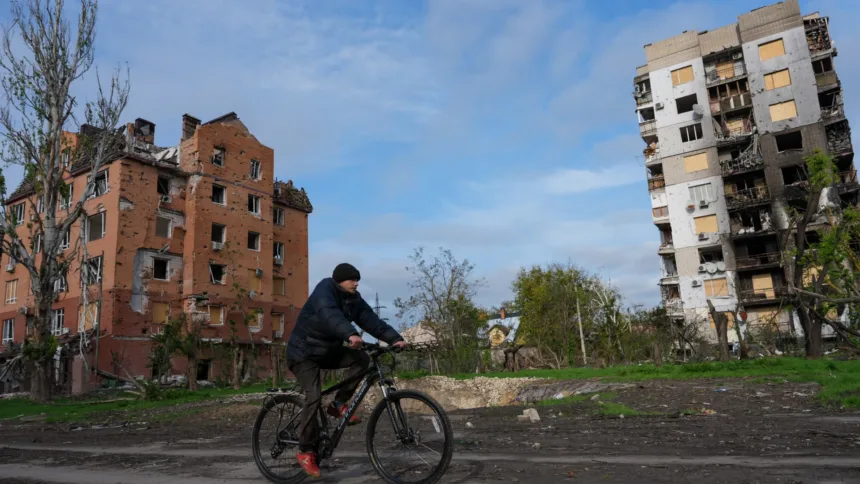
The breaches landed as a six-day truce around the Russian-occupied town of Oleshky expired at midnight Moscow time. Brokered with help from first lady Melania Trump and Pope Leo XIV, the pause allowed hundreds of residents to evacuate and was the most significant truce since Russia's full-scale invasion in 2022.
Fighting resumed within hours. Kherson's military administration said a Russian drone struck a hospital at 7:40 a.m. Monday without injuring anyone, while regional officials said a 62-year-old woman and a 73-year-old man in Kherson were hospitalized with blast injuries.
Ukraine's General Staff accused Russia of using the pause to rotate troops, fortify positions and bring in ammunition. Peskov called regrouping standard practice, said he assumed Kyiv had done the same, and said Moscow had no plans for a truce elsewhere.
Dmytro Lubinets, Ukraine's human rights ombudsman and lead civilian negotiator for the mission, said he hopes the operation can serve as a model for others. He said it could build momentum for three-way talks among Ukrainian, Russian and U.S. officials expected this month.