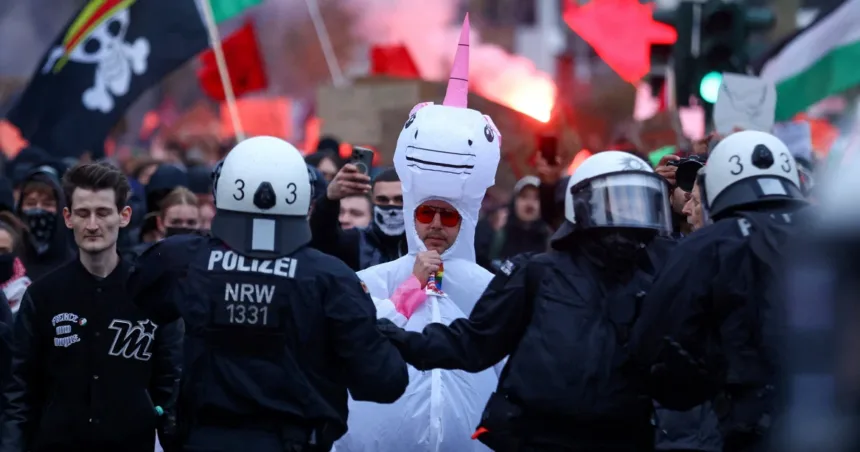
Clashes with police closed out a third straight weekend of youth-led protests in France on Saturday, after about 320,000 people marched nationwide over living costs and education, while rioters in Frankfurt, Germany, smashed storefronts and took weapons from a gun store.
The Interior Ministry's French tally included 70,000 people in Paris. It was the smallest of the three weekends, following 410,000 on Oct. 24 and more than 500,000 on Oct. 17, when some of the country's worst rioting in years broke out. Organizers put turnout higher.
Interior Minister Laurent Nuñez had warned of a very high risk of disorder after dark, and about 70,000 police and gendarmes were on duty. Authorities reported more than 560 arrests by Saturday night, compared with 1,300 a week earlier.
How the Paris march turned
After a last-minute court fight, the main Paris march was shifted to the Boulevards des Maréchaux, the avenues circling the city's edge, and away from stores, government buildings and tourist areas. For hours it felt like a street party, with techno music, trick-or-treating and costumes. Gallery assistant Cléo Farenc, 30, came as a beheaded Marie-Antoinette.
It's about embodying a figure of power who was brought down by the people
Cléo Farenc, gallery assistant
The mood turned near Porte de Charenton, where the route ended. Protesters threw bottles and fireworks, police answered with stun grenades and tear gas, and many peaceful marchers left coughing, some of them escaping into the Bois de Vincennes.
Paris police also closed Place de la Republique and Les Halles to the public overnight on Saturday and Sunday, between 11 p.m. and 6 a.m. Unaccompanied minors face a 9 p.m. curfew around the Champs-Elysees, after a Paris court on Wednesday suspended an earlier one, ruling that it seriously and illegally restricted freedom of movement.
Violence in Germany
In downtown Frankfurt, police later recovered the stolen guns. They said rioters threw stones and bottles at officers during the day and Molotov cocktails at night, and several officers were hurt, one severely.
The German marches were organized in more than 30 cities by a youth initiative called Gen Z regelt, which wants more spent on schools, health, climate protection and housing and opposes bringing back conscription. Organizers claimed tens of thousands of participants, but no official count was immediately available.
Police ended a Cologne march early after protesters threw stones, set off pyrotechnics and defied a ban on covering their faces. Water cannons were used there and in Hamburg, where officers also fired tear gas and barricades burned. Berlin added 1,500 officers for rallies that included a gathering at Brandenburg Gate.
What is driving the protests
The French movement began last month with high school students angry about too few teachers, run-down buildings and university admissions they consider unfair to disadvantaged applicants. Labor unions, the Yellow Vests and other opponents of President Emmanuel Macron later joined. Corentin Cabreux, a 21-year-old student, said his state-run residence has peeling, damp walls, cockroaches and rats.
Students in Germany voiced similar complaints. Janelle Schulz, a Berlin high school student, said authorities must spend more on education.
At my school, the ceiling is collapsing because of water damage, nothing is being done about it, we have a shortage of teachers, the toilets are broken
Janelle Schulz, Berlin high school student
Unrest across Europe
Italy is turning to its army. Prime Minister Giorgia Meloni's government said it would station 500 army troops with police in Milan through the end of the year after masked groups looted stores and threw projectiles at officers this month. Tens of thousands marched in Rome and other cities Friday, and police turned a water cannon on demonstrators.
Protests reached other capitals as well. Thousands rallied peacefully in Lisbon over Portugal's housing crisis, tents have filled a Madrid square since late last month, and tear gas and water cannons were used on black-clad protesters in Brussels. In The Hague, shops were boarded up against feared looting, but no major disturbances had occurred by midafternoon.