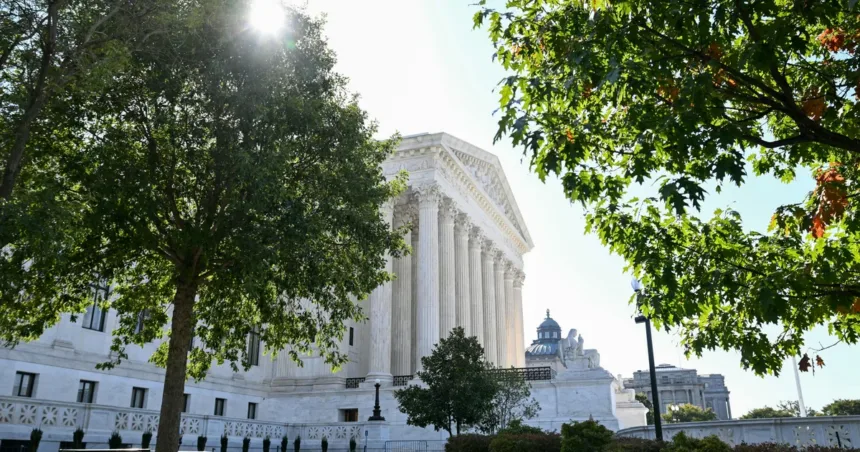
The Supreme Court on Monday refused the Justice Department's eleventh-hour bid to force California to pull aside mail ballots cast by roughly 20,000 people the administration says are likely not citizens, handing President Donald Trump a defeat the day before the midterm elections.
The justices moved within hours of the filing, issuing a single-sentence, unsigned order that gave no reasoning and recorded no dissents. They did not first seek a response from California, a step the court ordinarily takes with the opposing side.
Justice Elena Kagan referred the request to the full court, which includes three justices Trump appointed. California Attorney General Rob Bonta, a Democrat, called the outcome expected and said the court had not ruled this way without asking for a response since 2018.
This latest decision should put an end to the administration’s attempt to disrupt California’s elections through emergency court orders,
Rob Bonta, California attorney general
Gov. Gavin Newsom said the court had slapped down what he called a baseless attack on the state's electoral process.
How the lower courts ruled
The order caps a string of losses for the department. U.S. District Judge David Carter, a Clinton appointee, turned down its request on Oct. 28, raising doubts about the reliability of the Department of Homeland Security list behind it.
If the executive can discount votes and threaten an ongoing election due to unproven allegations, then our democracy is in danger,
David Carter, U.S. district judge
On Friday, a split three-judge panel of the 9th Circuit also declined to intervene. The majority, Judge Mark Bennett, named by Trump, and Judge Gabriel Sanchez, named by Biden, warned of a real risk of disenfranchising voters and invoked the Purcell principle against altering election rules just before a vote. Judge Patrick Bumatay, another Trump pick, dissented.
In asking the justices to act, Solicitor General D. John Sauer argued that violations of federal law injure the nation's sovereignty. He contended that once the disputed ballots are mixed with valid ones, they can never be pulled back out.
Doubts about the federal list
State and Los Angeles County officials have argued the list is unreliable and that building a system to segregate ballots in the middle of an election is not feasible. County registrar Dean Logan said the department had never shared the evidence, sources or methodology behind its claims.
The real number of contested ballots is probably far below 20,000, because county officials found many people on the list had no active registration and were never sent a ballot. Researchers at UCLA's Voting Rights Project, granted access through a court order in another case, found 42% of the names missing from the current voter roll, along with naturalized citizens.
California has more than 23 million registered voters. Ballots began going out in early October, and over 6 million had come back to election offices statewide.
Wider pressure on election officials
Late last week, a federal judge in San Francisco temporarily barred the administration from threatening or coercing election officials over processing ballots; the government has appealed. The department has also subpoenaed California election officials and warned them they could face criminal charges.
The fight extends beyond California. Washington Secretary of State Steve Hobbs said a federal list of more than 400 alleged noncitizens, whose ballots prosecutors wanted set aside, included many citizens. A judge on Sunday threw out a department suit aimed at Alaska's Senate certification.
Trump has repeatedly claimed that large numbers of noncitizens vote. Confirmed cases are rare, and federal law already makes voting by noncitizens illegal.