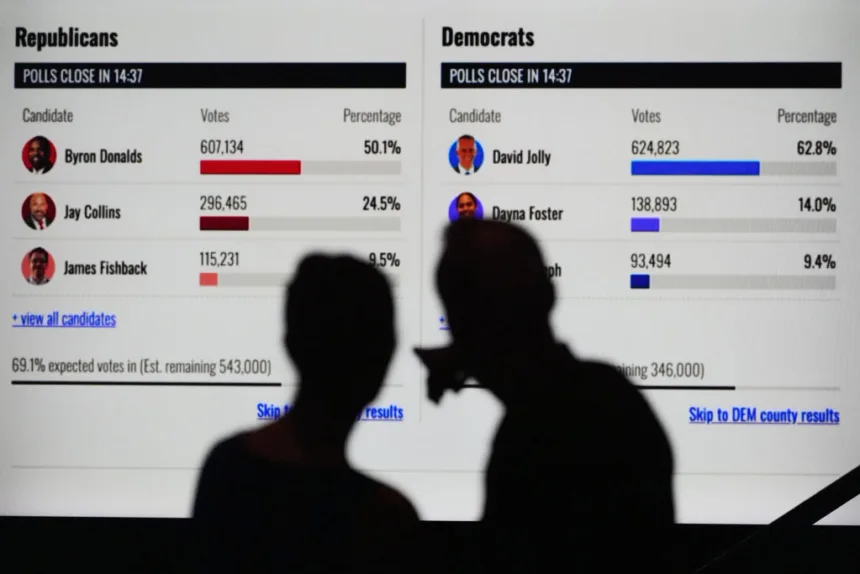
Voters who go to sleep on election night without knowing who won a close congressional race should not be alarmed. A candidate who trails in the evening may be ahead by morning, and both developments are ordinary features of vote counting.
That has not stopped false claims in the past. Officials, candidates and social media users have described late-arriving ballots as "ballot dumps" or "suitcases" of fraudulent votes. Others have falsely suggested that only cities led by Democrats need days to finish counting.
Why counts differ by state
Some states, including Florida, often finish most of their unofficial tallies faster than other places. Longer counts elsewhere are not evidence of wrongdoing. Election technology and cybersecurity expert Ryan Macias said states simply follow the counting and certification laws their legislatures have written. He said what changes is how quickly news organizations can gather enough data to project a winner, which usually depends on the margin.
No state must finish its official count on election night. Certification deadlines set by state law often fall weeks later. Joe Lenski, executive vice president of SSRS, which runs a national Election Day exit poll, said a few tight Senate and House contests always go undecided for several days. He said results in Alaska and California can take a week or two.
Polls and nonpartisan analysis rate many Senate races as competitive, including contests in Michigan, Maine, Iowa, Alaska, Kansas and Texas. Control of the Senate could hinge on a few close races with many ballots left to count. Some contests could go to recounts lasting days or weeks. In 2018, recounts decided three statewide races in Florida.
How early leads can mislead
Early leads can also be misleading. In Wisconsin in 2020, Donald Trump led by more than 100,000 votes early on election night. The picture shifted after Milwaukee's central count finished processing mail ballots at about 3:30 a.m. local time. That late gain for Joe Biden was expected because mail ballots in Wisconsin tend to lean Democratic.
Mail ballots take time because workers must confirm each voter's identity, for example by comparing envelope signatures with registration records. Most states, Florida among them, require mail ballots to arrive by Election Day. Others accept ballots that arrive later if they were postmarked by Election Day.
California, which conducts nearly all-mail elections, counts ballots postmarked by Election Day that arrive up to a week later. In June, the U.S. Supreme Court upheld states' right to adopt such rules. That ruling was a setback for Trump, who says he wants faster results and has spread falsehoods about how California counts votes.
Ohio moved in the other direction. A 2025 law requires most absentee ballots to arrive by the close of polls on Election Day, ending a four-day grace period. In California, counties must count and report most ballots by the 13th day after the election. Provisional ballots and mail ballots that need signature verification are exceptions, and officials should finish those within 30 days.
Inside Detroit's count
Michigan's Senate race may stay unresolved until Detroit has counted nearly all its ballots. City officials, who serve more than half a million voters, expect to report results for about 95% of ballots on election night. Daniel A. Baxter, Detroit's elections chief of operations, called that figure an estimate rather than a guarantee or a legal deadline.
The main unknown is how many absentee ballots arrive by the 8 p.m. Election Day deadline set by Michigan law. Baxter said officials will make every reasonable effort to finish tabulating by 4 a.m., though a late surge of absentee ballots could push the count past that. As of the evening of Oct. 26, about half of Detroit's 106,000 absentee ballots had been returned.
Detroit covers about 140 square miles and has 38 drop boxes. After polls close, it takes workers a few hours to gather ballots and drive them by truck to Huntington Place for counting. Smaller cities move faster. Troy, which has 66,000 voters and a handful of drop boxes, has finished counting before midnight in past elections, according to City Clerk M. Aileen Dickson.
No state releases mail ballot results before polls close. Some states, however, let officials start processing mail ballots early. That work includes confirming that a valid voter sent the ballot, checking signatures, and often removing ballots from security envelopes, flattening them and stacking them. A few states, including New Hampshire, do not allow processing to begin until Election Day.
Ranked choice in Maine and Alaska
Two states with competitive Senate races, Maine and Alaska, use ranked choice voting, in which voters list candidates in order of preference. A candidate who wins more than 50% of first choices wins outright. Otherwise, the last-place candidate is dropped, and those ballots shift to their next choice. The process repeats until one candidate passes 50%.
Alaska accepts ballots mailed from outside the U.S. for 15 days after Election Day, and the state has a long record of close races that take that long to count. California's races could take even longer this year. Any recounts could stretch into December or later. A contested 2024 race for the North Carolina state Supreme Court took roughly six months to resolve.
Alaska's Senate ballot lists four candidates. They include Republican incumbent Sen. Dan S. Sullivan and Daniel J. Sullivan Jr., who appears without a party affiliation. In an unusual step, the U.S. Justice Department sued on Oct. 22 to block certification if the incumbent loses, alleging that voters could be confused. Lawyers for Democrat Mary Peltola have asked the court to dismiss the case.
In Maine, Republican Sen. Susan Collins and Democratic challenger Troy Jackson share the ballot with six write-in candidates, so the race could go to ranked choice tabulation. Secretary of State Shenna Bellows said municipalities will report first-round results. She said the state will know within a day or two whether ranked choice rounds are needed. Historically, Maine has known the ranked choice result the week after the election.
Bellows said officials will move as quickly as they can but that accuracy and reflecting voters' wishes matter most.
How voters can help
Voters can also help the process. Mail voters should avoid waiting until the last minute, and many election offices offer secure drop boxes to speed returns. The U.S. Postal Service advises mailing ballots at least one week before the deadline.