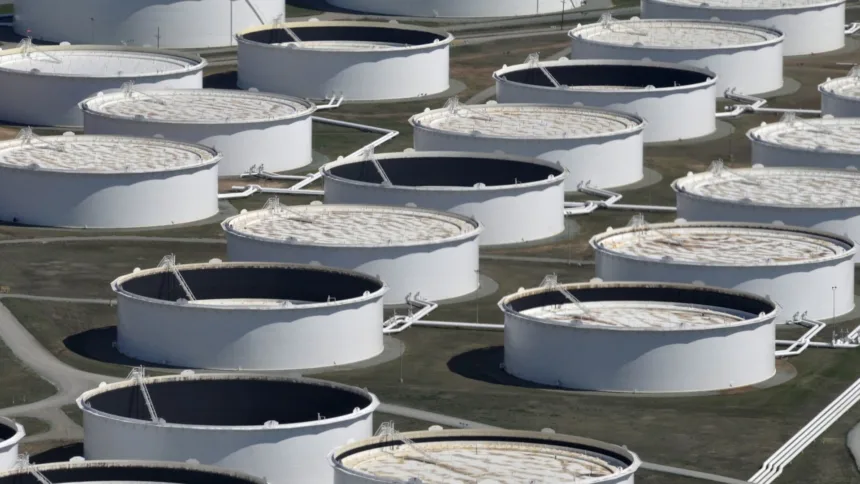
Oil suffered its sharpest one-day decline in more than three months on Monday after President Donald Trump and Iran's leaders both signaled interest in a negotiated end to the eight-month conflict, pushing U.S. crude below $100 a barrel on the eve of the midterm elections.
West Texas Intermediate futures settled at $96.46 after a 7.4% slide, the worst session for the U.S. benchmark since July 27. Brent, the global benchmark, dropped 7.6% and ended at $104.77.
Trump told reporters Monday that Iran wants a deal and that one could happen. Secretary of State Marco Rubio said over the weekend that the president would rather settle the conflict through diplomacy than force, adding that Trump has not decided whether to strike Iran again.
What the president expresses to you is incredible confidence that if we needed to do something militarily, we would have the ability to do it,
Marco Rubio, U.S. Secretary of State
Iranian President Masoud Pezeshkian said Tehran wants to resolve its problems through dialogue and that Supreme Leader Ayatollah Mojtaba Khamenei has given the government authority to pursue that. Foreign Minister Abbas Araghchi said a deal is possible if Washington shows goodwill, and that mediators are weighing a proposal Iran put forward at the United Nations General Assembly in September.
Araghchi said Tehran expects the U.S. to lift sanctions and its blockade and to scale its regional military presence back to earlier levels. The diplomatic push followed in-person talks in Qatar over the weekend, though Khamenei on Saturday told Iran's armed forces to answer any threat with an immediate response unlimited by geography.
Risk premium starts to unwind
Traders had been bracing for a major escalation after the elections, and crude climbed more than 10% in October. Trump has said he will not attack Iran before the midterms.
Earlier rounds of settlement talk also knocked oil lower, only for fighting to flare and prices to jump again. Ryan McKay, director of commodity strategy at TD Securities, said diplomatic headlines move the market because much of its recent rise reflected a premium for escalation risk, but he does not expect that premium to vanish while the war continues.
so long as there is no concrete conclusion to the war, and tanker and Houthi attacks remain prevalent, we do not anticipate a complete erosion of the risk premium via diplomacy headlines alone
Ryan McKay, director of commodity strategy at TD Securities
Relief at the pump
Gasoline averaged $4.17 a gallon for regular on Monday, according to the American Automobile Association, 12 cents lower than a week earlier and 23 cents below a month ago. A year ago the average was $3.04, and it stood at $2.98 on Feb. 28, the day the U.S. and Israel first struck Iran.
Diesel averaged $6.29, down 6 cents on the week. It first crossed $6 in September and peaked at $6.53.
Patrick De Haan, head of petroleum analysis at GasBuddy, said wholesale gasoline and diesel prices point to a decline of roughly 16 cents a gallon, and that the national gasoline average could dip below $4 within a week unless conditions change.
Costs on voters' minds
A poll last month found a majority of Americans want Congress to prioritize cost-of-living issues, including 78% of Republicans and 89% of Democrats. White House spokesperson Taylor Rogers said gas prices will fall sharply once the conflict ends and credited the U.S. military with pushing Persian Gulf oil exports above their prewar level.
Energy stocks lagged in midday trading, with ConocoPhillips off 3.7%, ExxonMobil down 3.3% and Chevron 2.3% lower. The broader market rose: the Dow Jones Industrial Average gained 1%, the Nasdaq 0.7% and the S&P 500 0.6%.