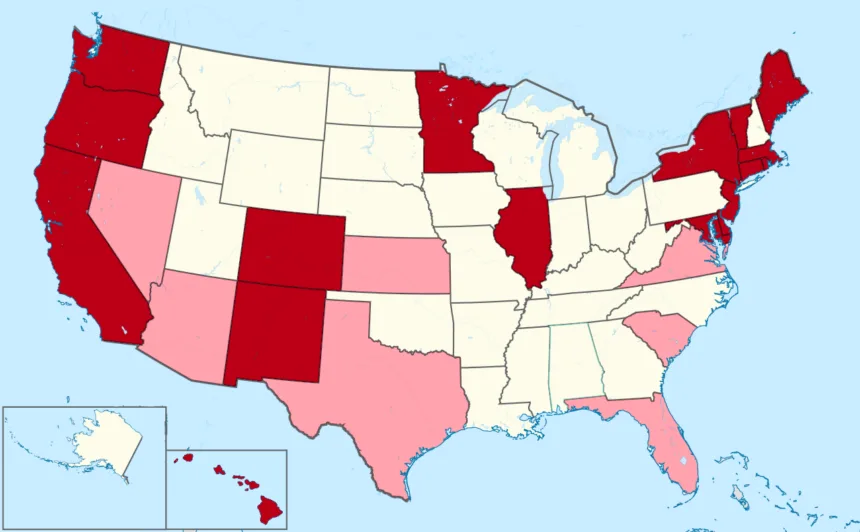
Democrats who just seized full control of five battleground states are moving to join the National Popular Vote Interstate Compact. If they succeed, the pact could clear the 270 electoral votes it needs to take effect before the 2028 presidential election.
Pennsylvania, Michigan, Wisconsin, Nevada and Arizona now have Democratic governors and Democratic majorities in both legislative chambers. Lawmakers in key states said they had already begun conversations this week about introducing bills to join the compact next session and hoped to pass them ahead of 2028.
The compact's current members, 18 states and Washington, D.C., control 222 electoral votes. Adding Pennsylvania's 19, Michigan's 15, Arizona's 11, Wisconsin's 10 and Nevada's 6 would bring the total to 283, assuming all five join and the agreement survives potential constitutional challenges.
Under the agreement, member states pledge to award all their electoral votes to the presidential ticket that wins the most votes nationwide, regardless of the result within their borders. It activates only once members hold at least 270 electoral votes and requires no constitutional amendment, because the Constitution lets each legislature decide how its electors are chosen.
Michigan state Rep. Carrie Rheingans, a Democrat, said the time is right and that the blue tsunami would help push the effort forward nationally. Kelda Roys, a Democratic lawmaker in Wisconsin, said the national popular vote would be prioritized early in the session.
Others are less certain it will top the agenda after a campaign fought largely over the cost of living. Wisconsin Democratic Assemblyman Clinton Anderson said time will tell.
I want to make it a priority, but it's not the thing I heard on the doors I knocked.
Clinton Anderson, Democratic state assemblyman in Wisconsin
The new majorities have stumbled before. Michigan failed to pass the compact during its last Democratic trifecta in 2023 and 2024, and Nevada's then-Democratic governor vetoed it in 2019 amid fears it could shrink the small state's outsized influence in presidential races.
Virginia became the latest member after Democrats won a trifecta there in 2025. Republicans called that move an unconstitutional assault on democracy and argued it undermines the influence of Virginia voters.
Courts could pose the bigger obstacle. Notre Dame law professor Derek Muller has argued the compact would be unconstitutional without congressional approval under the Constitution's Compact Clause; he called enough states joining a very real possibility but predicted many challenges.
Computer scientist John Koza, a former Democratic elector, introduced the compact in 2006, and Maryland became the first state to sign on in 2007. The idea gained traction after George W. Bush in 2000 and Donald Trump in 2016 won the presidency while losing the popular vote, outcomes that made Democrats more open to the change and Republicans generally more opposed.