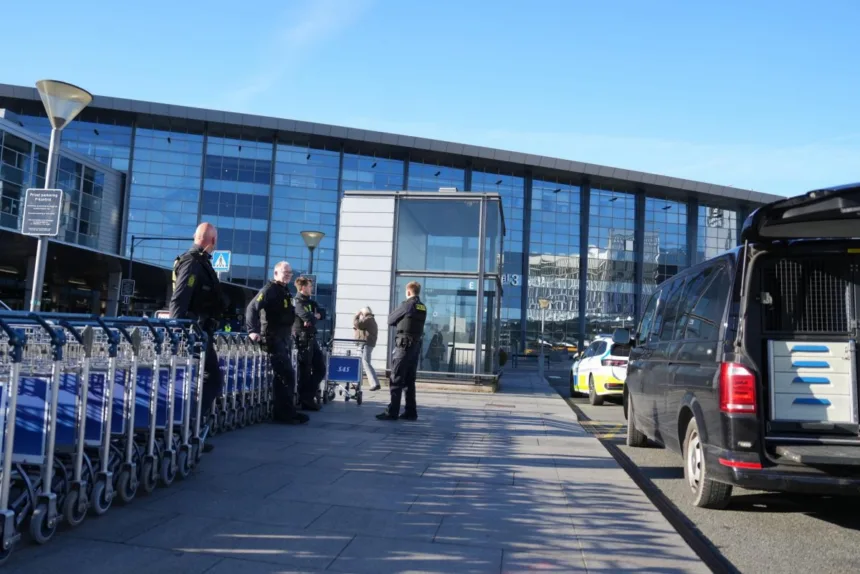
Hoax bomb threats struck flights to and from Lisbon, Rome, Prague and Sofia on Friday, the third such wave this week. Broadcasters and newspapers in Ireland and elsewhere evacuated staff, and Ireland's government called it a likely coordinated campaign of disruption.
Authorities said three of the targeted planes were escorted by Hungarian fighter jets. As of Friday, no explosives had been found on any aircraft.
At least 18 flights were disrupted Friday, pushing the week's total past 50, and Prague drew the most threats, with nine. Ryanair said a flight scheduled to leave Lisbon for Rome was targeted, and France reported threats against at least four of its flights, all of which landed safely.
Newsrooms cleared
Ireland's public broadcaster RTÉ evacuated its building after a threat. Staff at the Irish Independent and at the Dublin offices of radio stations Newstalk and Today FM were told to leave, and the Irish prime minister's office said Virgin Media was also threatened.
News organizations in Bulgaria and Britain were targeted as well. British broadcaster Sky confirmed it received a security threat hours after RTÉ cleared its building, and said it had run a security assessment and alerted authorities.
The Irish government said it does not yet know whether individuals or an organized effort is responsible. No concrete link has been established between the threats to airlines and those to media outlets, and Irish police said they were aware of a threat against media organizations in Ireland and across Europe.
Hoax threats such as these cause fear, distress and disruption to people going about their daily lives and activities; they achieve no positive purpose whatsoever.
Irish government statement
Prime Minister Micheál Martin called the situation worrying and said protecting the Irish public was his government's first priority. He said the threats were being taken seriously, and noted what appeared to be coordinated efforts to disrupt air travel the day before. Ireland is due to host two high-profile European Union meetings in Dublin next week.
Who is behind it
Earlier this week, threats affected nearly 30 aircraft and several airports across Europe, a wave Britain called a malicious hoax.
The Russian extremist group Male State, named in hoax threats to Italian airports this week, denied involvement. A Telegram account linked to the group and its founder, Vladislav Pozdnyakov, mocked the suggestion and said the group had not existed for many years.
A separate group appeared to claim responsibility for the threats and warned that more would follow, but the claim has not been substantiated.
Italian Prime Minister Giorgia Meloni said it was unclear whether the threats were tied to recent attacks on blood banks in France and on refrigeration systems in several countries, but called the events a cause for concern. She argued that protecting such systems shows why both defense and health care need funding.