A federal judge late Thursday froze construction of President Donald Trump's 250-foot triumphal arch in Washington for 14 days. She acted less than two hours after a planning commission stacked with his allies gave the project final approval.
U.S. District Judge Tanya Chutkan granted a temporary restraining order sought by the District of Columbia and Virginia. In a 33-page opinion, she found the arch likely runs afoul of federal law, that building it would cause immediate and irreparable harm, and that a pause serves the public interest.
The order stopped work the administration was ready to launch right away. Justice Department lawyers had said six to eight months of excavation and foundation work could start as soon as Thursday, with above-ground construction no earlier than May 2027 and the full job lasting 33 to 39 months.
The National Capital Planning Commission approved the arch 8-4 after nearly nine hours of testimony, most of it from opponents. D.C. Council Chair Phil Mendelson, a Democrat on the panel, tried to delay the vote until final site and building plans were submitted, but his motion failed 4-8.
Two Republican congressmen who are veterans, Brian Mast of Florida and Andrew Clyde of Georgia, were among the handful who spoke in favor. Commission Chair Mark Paoletta, a Trump appointee, said the arch would honor veterans and give Arlington National Cemetery a fitting grand entrance.
Chutkan was unmoved by the administration's recent effort to cast the arch as a national security asset. She wrote that the security features described in sworn declarations, including one from Defense Secretary Pete Hegseth, appear nowhere in the planning documents, and that government lawyers offered nothing more at a hearing.
At the commission meeting, Interior Department official Greg Wischer acknowledged under questioning from Mendelson that specific security functions had been filed with the court under seal and that the National Park Service knew nothing of any defense preparations. Trump has said the structure would house drones and snipers.
The administration's main legal claim is that it needs no new approval from Congress. It points to a 1925 law that cleared two 166-foot columns for Memorial Circle, columns that were never erected, and argues that authority still stands. Chutkan called it highly improbable that a century-old statute held a power no earlier administration had known about.
The case combines two challenges. Vietnam War veterans and an architectural historian, represented by the advocacy group Public Citizen, sued earlier this year, and Virginia and the District of Columbia filed their own suit on Saturday. Both argue the arch is illegal without congressional approval.
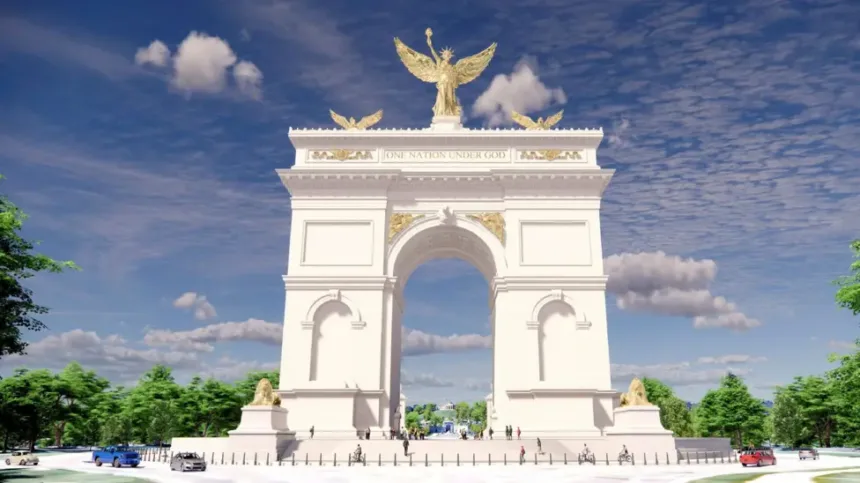
The arch would rise on Memorial Circle, a traffic island on the bridge between the Lincoln Memorial and Arlington National Cemetery, near the final approach to Ronald Reagan Washington National Airport. It would nearly match the 288-foot U.S. Capitol and be topped by a 60-foot gold winged figure holding a flame.
Many who testified have relatives buried at Arlington or plan to be buried there. Critics say the arch would put some graves in shadow, block a historic view and add risk to crowded airspace; the administration says it would honor veterans.
The White House was undeterred. Spokesperson Davis Ingle attacked the ruling as the work of an activist court and predicted the administration would prevail, and on Friday the White House rolled out a website for what it now calls the Military Triumphal Arch, describing sniper positions on an observation deck and a base built for launching drones.
Democrats, who regain a majority in Congress in January, have vowed to block the arch and investigate it. Rep. Don Beyer of Virginia has introduced a bill to prohibit and defund the project and said he expects its 80 co-sponsors to reach at least 200 next year.
the courts and Congress must put in place permanent safeguards to stop the Trump Administration from violating the law and proceeding with this project
Rep. Don Beyer, D-Va.
Rep. Jared Huffman of California, who expects to lead the House committee overseeing environmental and historic preservation law, cautioned commissioners that officials and companies pushing a project Congress never authorized were exposing themselves to legal risk.