The Justice Department on Friday asked a federal court to throw out its own lawsuit seeking to block California from counting about 20,000 ballots it claimed went to noncitizens. The retreat came days after Republicans took heavy losses in the midterm elections.
The request landed roughly a week before a special master was due to hold a hearing on whether the federal list was accurate. The department argued in its motion that by then the state would have irreversibly mixed the disputed ballots with valid ones, leaving it no remedy to pursue.
California officials have called the list outdated and said it contains legitimate voters. U.S. District Judge David O. Carter, a Clinton appointee, voiced the same view when he rejected the government's request, warning that pulling ballots aside so late would risk disenfranchising citizens.
The case faced a timing problem from the start. Prosecutors sued in mid-October, after ballots had been mailed to all 23 million registered voters and hundreds of thousands had already been processed and anonymized. Bill Essayli, the top federal prosecutor in Los Angeles, had told the court the suit would become moot after Election Day because those ballots could not be isolated.
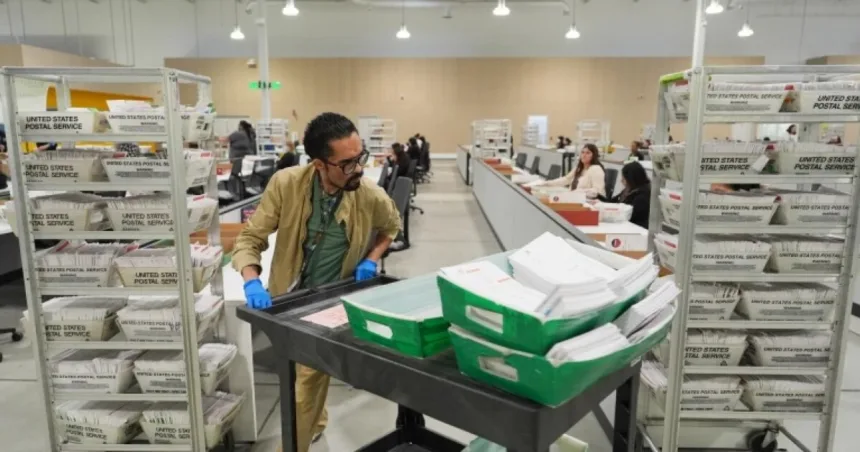
State election officials said about 9 million California ballots had been tallied by Friday morning. Close to 5 million more were still waiting to be counted.
A parallel loss in Washington
The dismissal followed a defeat in Washington state. On Thursday, U.S. District Judge Jamal Whitehead in Seattle ruled that the administration cannot compel election officials to set aside ballots from more than 400 voters whom federal prosecutors alleged are noncitizens.
Prosecutors Charles Neil Floyd and Pete Serrano had claimed last week that at least 405 noncitizens on the state's rolls cast upward of 1,500 votes over decades. Secretary of State Steve Hobbs, a Democrat, said the list included citizens and offered no proof of anyone's status.
The 9th U.S. Circuit Court of Appeals has held that federal officials may ask states to hold ballots back but cannot order them to. Whitehead, a Biden appointee, concluded the prosecutors were not merely asking. His order lasts two weeks, with a hearing on a longer injunction set for Nov. 18, and it does not bar prosecution of unlawful voters.
Voters who followed the rules should not lose their votes to a list that even its authors admit may include citizens.
Jamal Whitehead, U.S. District Judge
Immigrant advocacy and labor groups brought the Washington case. Justice Department spokesperson Kiersten Pels said the agency was reviewing the order and noted that a temporary restraining order is not a final ruling on the merits.
A wider campaign over elections
Both suits were part of President Donald Trump's push to exert control over state-run elections, which he has called rife with illegal voting without offering evidence. A separate suit seeking to block the Democrat's win in Alaska's Senate race was quickly dismissed; the administration is appealing but has not yet filed a full brief.
Advocacy groups are also contesting how the department uses its roster of suspected noncitizens. Meanwhile, California prosecutors have arrested more than 30 noncitizens accused of registering illegally, and election clerks have been subpoenaed to testify before grand juries scheduled to meet in November.